Dog grooming supplies for professional groomers cover clipper systems, bathing stations, tables, and coat tools built to run back-to-back appointments, not one dog on a Saturday. A home groomer buys for one coat type; a working groomer buys for every breed that walks through the door, and equipment failure mid-appointment costs bookings, not just annoyance.
The gap between home-grade and professional-grade gear shows up fastest in motors and blades. A $40 clipper handles a Chihuahua touch-up once a month; it stalls on the third double-coated Husky of the day. Shop and Bark stocks dog grooming supplies for professional groomers who need equipment rated for daily, multi-dog use, and this guide breaks down what to stock, in what order, and what setups fit which business model.
- Professional dog grooming supplies need commercial-grade motors, backup blades, and dryers rated for daily double-coat volume in 2026.
- Shop and Bark carries dog grooming supplies for professional groomers across bathing stations, ear care, and coat tools.
- Cross-contamination control between dogs matters more in a salon than at home - one shared brush spreads mites fast.
- Fine finishing blades dull faster than coarse guard blades because face hair packs the teeth quicker.
- A grooming table's weight rating should exceed the heaviest breed on your books, not the average.
Why dog grooming supplies matter more for professional groomers
A home groomer tolerates a slow dryer or a dull blade because there's no line of clients waiting. A working groomer can't. Every extra ten minutes drying a Golden Retriever pushes the next three appointments later, and a blade that drags on a Doodle's undercoat means redoing the section by hand.
The other difference is exposure. A professional setup touches dozens of different dogs a week - different skin conditions, different temperaments, different parasite risk. Home grooming supplies rarely account for sanitation between animals because there's only ever one animal. A salon setup has to.
Standardize your pre-groom intake check
Before any tool touches a dog, professional groomers run a quick physical and behavioral check. This costs nothing and prevents the two most common salon liabilities: aggravating an existing skin issue and missing a temperament flag that leads to a bite.
- Check coat condition and matting severity before choosing a blade or comb
- Flag any skin irritation, hot spots, or open sores before bathing
- Note temperament (nervous, reactive, senior) on the intake card
- Confirm medication or allergy notes from the owner
- Check nail length and quick visibility before trimming
Set up a dedicated bathing and drying station
A fixed bathing station beats a bathtub setup the moment you're doing more than two or three dogs a day. Height-adjustable tubs cut down on groomer back strain, and a dedicated drain catch keeps hair out of plumbing lines that otherwise clog weekly.
- Adjustable-height tub or raised basin to reduce bending
- Non-slip flooring and tub liner rated for wet paws
- Multi-speed, high-velocity dryer for double-coated breeds
- Water temperature control to avoid scalding sensitive skin
- Drain hair catch to prevent plumbing backups
Shop and Bark's guide to dog bathing stations breaks down setups that scale from a single-dog home tub to a higher-volume station, useful even for groomers building out a first bay.
Stock clipper and blade systems for coat variety
One clipper and one blade doesn't cover a client list that includes a Yorkie, a Golden Doodle, and a Rottweiler in the same day. Professional clippers need enough torque to run through thick or matted coats without heating up, and blade inventory needs to match every coat length on the books.
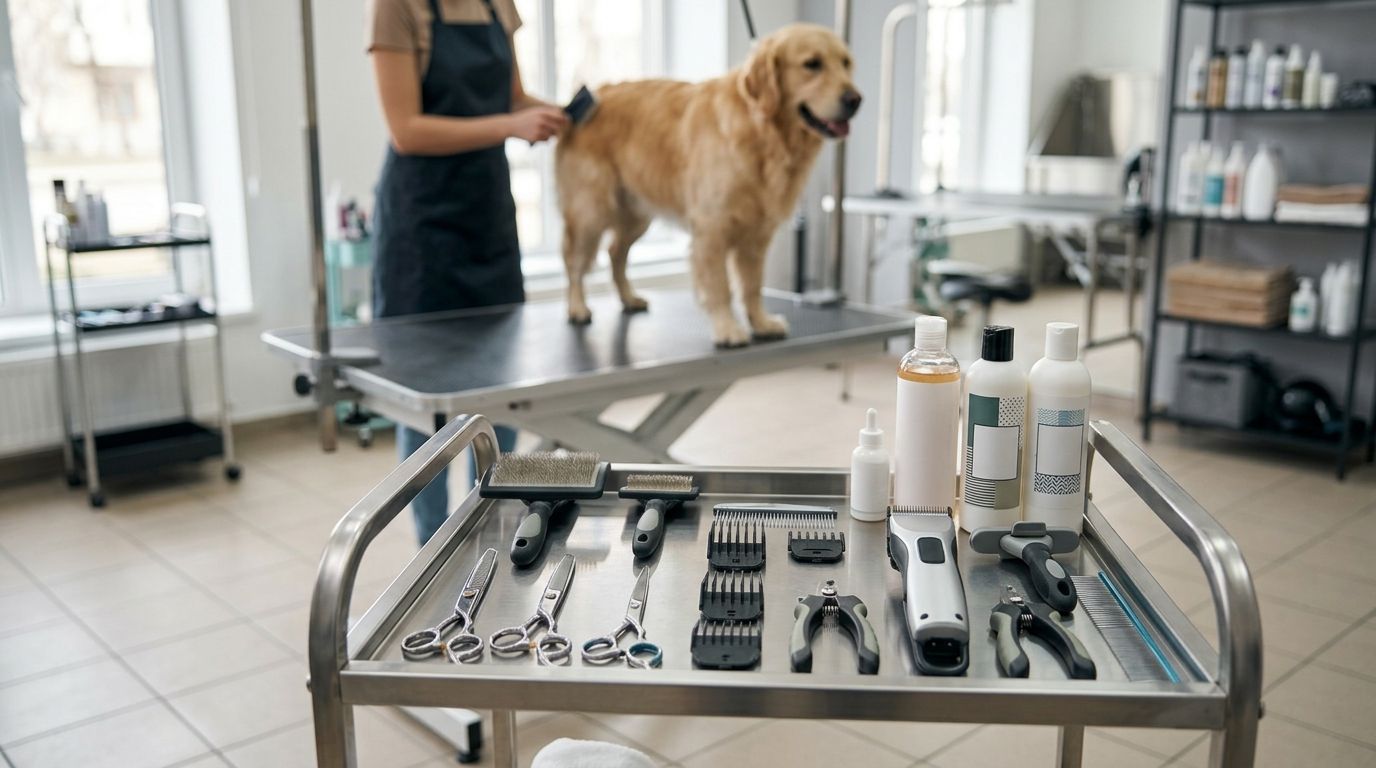
- Cordless clipper for mobility, corded backup for continuous power
- Blade set covering short (#10, #15) through long (#3F, #4F) lengths
- Backup blades for high-volume days - a dull blade drags and burns skin
- Blade coolant and oil to prevent rust and reduce drag between uses
- Guard combs for length adjustments without blade changes
Match brushes and de-shedding tools to coat type
The wrong brush on the wrong coat wastes time and irritates skin. Curly coats need different tension than double coats, and a slicker brush built for a Poodle will skip right over a Husky's undercoat.
- Slicker brush for curly and wavy coats (Poodles, Doodles)
- Undercoat rake for double-coated breeds (Huskies, Shepherds, Retrievers)
- Pin brush for long, silky coats (Yorkies, Maltese)
- Bristle brush for short, smooth coats (Beagles, Boxers)
- Dematting comb for tangled or neglected coats
- Detangling spray to reduce pulling on sensitive skin
Stock ear, eye, and dental care supplies
Grooming isn't just coat work. Ear cleaning, eye stain treatment, and a quick dental pass round out a full-service appointment and catch issues owners often miss between vet visits.
- Ear cleaning wipes or solution for wax and debris removal
- Cotton balls or pads, never cotton swabs, for ear cleaning
- Eye stain remover pads for tear staining around the eyes
- Styptic powder on hand for accidental quick nicks during nail trims
- Dental wipes or a finger brush for a post-groom dental pass
Shop and Bark's ranked list of dog ear cleaning wipes covers options that hold up across a full client roster, and the dog dental care kits guide ranks options by effectiveness for groomers offering dental add-ons.
Outfit the grooming table and restraint system
A table that flexes or a loop that slips is a safety issue, not a convenience gap. Weight capacity matters most here - rate the table for your heaviest client, not your average one.
- Hydraulic or electric table for height adjustment between dogs
- Grooming arm and loop rated for the dog's size and behavior
- Non-slip table mat to prevent shifting during trims
- Weight capacity that exceeds the largest breed on your client list
- Table-side storage for quick access to blades, brushes, and wipes
Shop and Bark's dog grooming tables ranked by price covers options across capacity ranges for solo groomers and multi-station salons alike.
Manage sanitation between clients
This is the step home grooming skips entirely and salons can't. One infected brush or unwashed table surface passes mites, ringworm, or bacteria from one dog to the next inside a single afternoon.
- Kennel-grade disinfectant spray between every dog, not just end of day
- Separate or sanitized brushes per dog, never shared without cleaning
- Disposable or wipeable table covers changed between appointments
- Gloves for any dog with visible skin irritation or open sores
- Dedicated laundry protocol for towels, with separate bins for soiled items
Stock your grooming kit for 2026
Browse dog grooming supplies for professional groomers in one place.
Comparing grooming business setups
The right supply list changes depending on how the business runs. A mobile van needs compact, low-water-use gear; a storefront salon can run heavier stations.
| Setup | Best for | Key limitation |
|---|---|---|
| Mobile grooming van | Groomers covering multiple neighborhoods or house calls | Limited water and power capacity forces smaller, lighter equipment |
| Storefront salon | High-volume groomers running back-to-back bookings | Higher fixed overhead requires steady client flow to justify |
| In-home salon | Solo groomers keeping overhead low | Space constraints cap table size and dryer noise tolerance |
| Add-on at boarding or vet facility | Facilities offering grooming as a secondary service | Shared space limits bathing station customization |
Common mistakes professional groomers make
- Buying home-grade clippers for salon volume - the motor overheats by the third double-coated dog of the day.
- Sharing one brush across every dog without sanitizing - this is how mites and fungal issues spread through a client base.
- Skipping backup blades - a dull blade mid-appointment either drags on skin or eats fifteen minutes of downtime.
- Underestimating dryer power for double coats - a standard dryer doubles drying time on Huskies and Shepherds, backing up the whole schedule.
- Rating tables for average weight, not max weight - a table rated for 80 pounds flexes under a 110-pound Mastiff.
FAQ
What dog grooming supplies do professional groomers need to start in 2026?
A professional setup needs a commercial-grade clipper with backup blades, a hydraulic or electric table rated for your heaviest client, a high-velocity dryer, and a bathing station with non-slip flooring. Ear, eye, and dental care add-ons round out a full-service appointment.
How often should groomers replace clipper blades?
Replace or sharpen blades as soon as they drag instead of gliding through coat, which happens faster on fine finishing blades than coarse guard blades. Waiting until a blade fully dulls risks skin irritation on the dog.
What's the difference between home grooming supplies and professional-grade supplies?
Professional-grade supplies are built for daily, multi-dog use with stronger motors, replaceable parts, and higher weight or CFM ratings. Home grooming supplies work fine for occasional use on one or two dogs but stall or wear out fast under salon volume.
Do professional groomers need a hydraulic grooming table?
Not always, but a height-adjustable table reduces back strain across a full day of appointments and speeds up positioning for different-sized dogs. It matters most for groomers running eight or more dogs a day.
How do groomers prevent cross-contamination between dogs?
Sanitize or swap brushes between every dog, disinfect the table surface after each appointment, and use gloves on any dog with visible skin irritation. Shared, unsanitized tools are the most common way mites and fungal infections spread through a client base.
Is a mobile grooming van better than a storefront salon?
A mobile van suits groomers covering multiple neighborhoods or offering house calls, but limited water and power capacity forces smaller equipment. A storefront salon supports heavier stations and higher daily volume but carries more fixed overhead.
What coat tools does a professional groomer need beyond clippers?
A slicker brush for curly coats, an undercoat rake for double coats, a pin brush for long silky coats, and a dematting comb for neglected coats cover most client breeds. Matching the tool to the coat type prevents skin irritation and wasted time.
One last thing
The blade that dulls fastest in a working shop isn't the coarse guard blade used on bodies - it's the fine finishing blade used on faces, because finer hair packs the teeth quicker than coarse coat does. Groomers who rotate finishing blades on a shorter cycle than body blades avoid the mid-appointment drag that irritates skin around a dog's eyes and muzzle.