
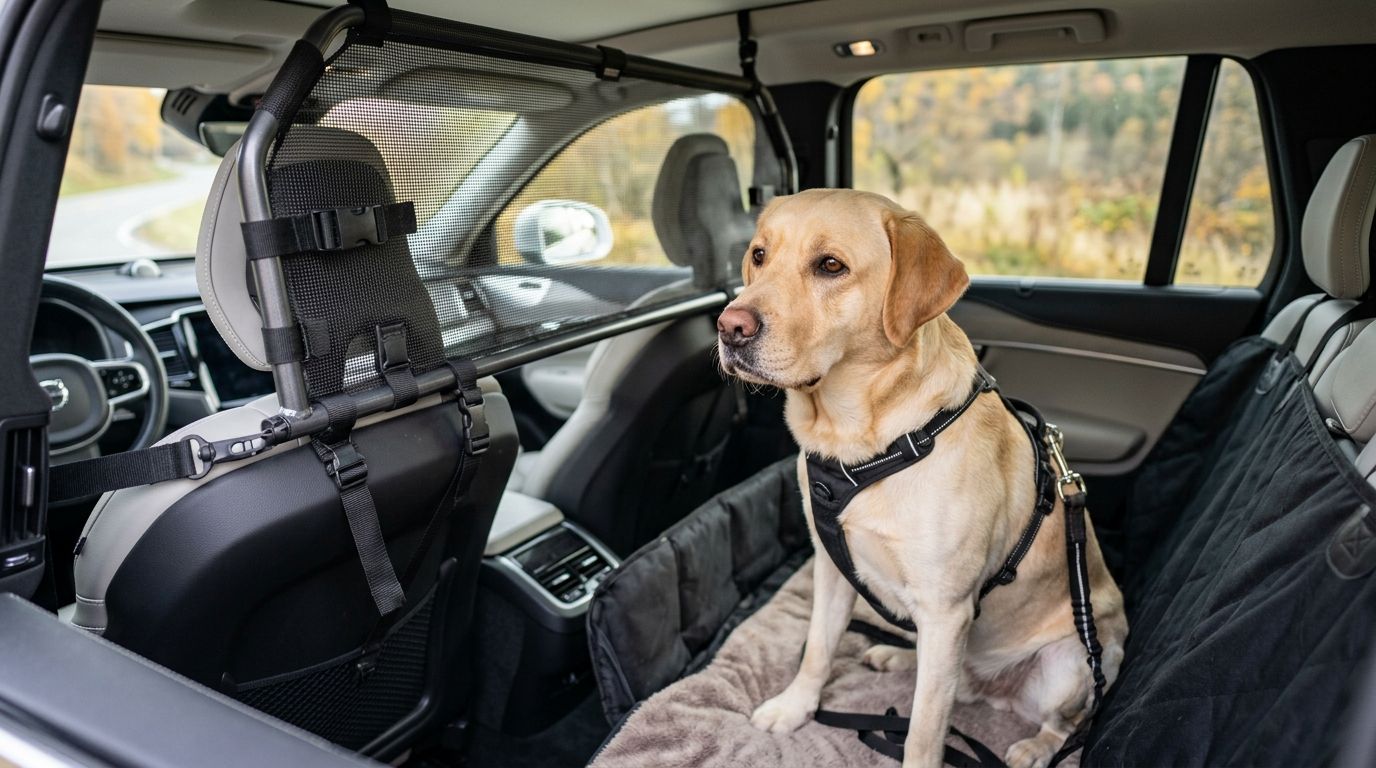
A dog car seat safety barrier keeps your dog contained in the back seat or cargo area during a drive, and the right pick depends on your vehicle shape and your dog's size and strength. Best overall: full-width steel tension-rod barrier. Best for SUV and hatchback cargo areas: mesh vehicle barrier. Best budget/dual-purpose option: combination barrier and hammock seat cover.
- Full-width steel tension-rod barriers win overall for large or strong dogs in 2026 — buy first.
- Mesh vehicle barriers fit SUV and hatchback cargo areas best but sag under sustained pawing.
- Backseat divider nets suit sedans without a cargo area; skip them for the largest dogs.
- Multi-panel adjustable barriers work across two vehicles, ideal for multi-car households.
- Combination barrier-and-hammock covers trade containment strength for seat protection and versatility.
Why this matters
A loose dog in a moving vehicle is a distraction and a projectile risk during sudden braking. Vehicle safety groups have flagged unrestrained pets as a driver-distraction factor for years, and a barrier addresses the containment half of that problem — it stops your dog from climbing into the front seat or footwell, though it does not replace a crash-tested harness for impact protection.
Most dog car seat safety barriers fall into a handful of physical designs, not brands, and picking the wrong design for your vehicle is the most common mistake. A mesh barrier built for a compact SUV cargo opening won't tension properly across a minivan's wider back seat, and a rigid metal barrier sized for a hatchback can rattle loose in a full-size sedan. Shop and Bark treats barrier selection as a fit problem first and a feature problem second, which is how the dog travel and containment gear range is organized.
What makes the best dog car seat safety barrier
- Fit accuracy — adjusts to your specific cargo width or backseat gap without gaps a dog can push through.
- Containment strength — resists a 40-90 lb dog leaning or pawing at the barrier repeatedly on a long drive.
- Installation method — tension rods, seat anchors, or headrest straps that don't require drilling or permanent hardware.
- Visibility — doesn't block the rearview mirror or driver sightlines, a common complaint with tall panels.
- Durability against chewing — matters more for dogs that redirect anxiety onto the barrier itself.
- Vehicle compatibility — works in the specific body style (SUV, sedan, hatchback, truck) you actually drive.
Dog car seat safety barriers at a glance
| Barrier type | Best for | Standout feature | Key limitation |
|---|---|---|---|
| Full-width steel tension-rod barrier | Large or strong dogs | Rigid frame resists pushing and leaning | Heavier to install and remove for cleaning |
| Mesh vehicle barrier | SUV and hatchback cargo areas | Folds flat for storage between trips | Mesh sags after months of repeated pawing |
| Backseat divider net | Sedans without a cargo area | Low-profile, doesn't block rear sightlines | Weaker containment for the largest dogs |
| Multi-panel adjustable barrier | Two-vehicle households | Reconfigures width for different back seats | Takes longer to refit for each vehicle |
| Combination barrier + hammock cover | Budget or dual-purpose buyers | Protects seats and contains the dog in one piece | Less rigid containment than a dedicated barrier |
1. Full-width steel tension-rod barrier: best dog car seat safety barrier for large or strong dogs
This design uses a rigid metal frame wedged between the floor and roof or door frames with tension rods, creating a fixed wall between the cargo area and back seat. It's the closest thing to a permanent fixture without actual installation. It's also the design most likely to survive a determined 70 lb dog leaning into it on every turn.
Steel tension-rod barrier pros:
- Handles sustained pressure from large or anxious dogs without flexing
- No fabric or mesh to tear from claws or teeth
- Stays in place over rough roads better than strap-mounted designs
Steel tension-rod barrier cons:
- Bulkier to remove when you need the cargo space for non-dog cargo
- Can rattle in vehicles with wider-than-average cargo openings
- Heavier than mesh or net alternatives, which matters if you swap it between cars
Best for: owners of dogs over 50 lbs, or any dog that actively tests the barrier. Verdict: Buy.
2. Mesh vehicle barrier: best dog car seat safety barrier for SUV and hatchback cargo areas
A mesh barrier stretches a reinforced panel across the cargo opening, anchored to the headrests or door frames with straps. It's the most common style sold for compact and midsize SUVs because it folds down small enough to store in a door pocket between trips.
Mesh barrier pros:
- Lightest and easiest barrier type to install and remove
- Doesn't scratch interior trim the way a rigid frame can
- Works in vehicles where the cargo opening is too irregular for a fixed steel frame
Mesh barrier cons:
- Sags or stretches after repeated pushing from medium-to-large dogs
- Straps loosen over long drives, so a mid-trip check is smart
- Not suited to dogs that chew fabric out of anxiety
Best for: small-to-medium dogs in SUVs and hatchbacks that need occasional, not constant, containment. Verdict: Buy.
3. Backseat divider net: best dog car seat safety barrier for sedans
Sedans have no separate cargo compartment, so the barrier's job shifts to keeping the dog in the back seat rather than out of the trunk. A divider net mounts between the front headrests and stretches low enough to block a dog from climbing over the center console.
Divider net pros:
- Low-profile design that doesn't obstruct the rearview mirror
- Installs in under five minutes with headrest hooks, no tools
- Compact enough to leave installed permanently
Divider net cons:
- Weaker containment once a large dog leans hard against it
- Some models leave a gap near the center console that small dogs squeeze through
- No help at all if your dog jumps rather than climbs
Best for: sedan owners with dogs under roughly 60 lbs. Verdict: Buy for small dogs, Hold for larger ones.
4. Multi-panel adjustable barrier: best dog car seat safety barrier for multi-car households
This design uses interlocking or telescoping panels that expand and contract to fit different backseat and cargo widths. That matters when the dog rides in two different vehicles, and it trades a bit of rigidity for the flexibility.
Multi-panel barrier pros:
- Reconfigures for SUV, sedan, or minivan widths without buying a second barrier
- Panels can be added or removed as your vehicle situation changes
- Sits between mesh and steel on containment strength
Multi-panel barrier cons:
- Refitting between vehicles takes longer than a single-vehicle barrier
- More moving parts mean more points that loosen over time
- Not as rigid as a dedicated steel barrier for the largest dogs
Best for: two-car families sharing one dog between vehicles. Verdict: Buy.
5. Combination barrier and hammock cover: best dog car seat safety barrier on a budget
This style combines a rear seat cover with an attached barrier panel, protecting the upholstery from mud and hair while also blocking the front seat gap. It's the option owners reach for when one purchase has to solve seat protection and containment together.
Combination barrier pros:
- Handles seat protection and containment in a single piece of gear
- Simple strap or hook-and-loop installation across the back seat
- Good starting point if you don't yet know how much containment your dog needs
Combination barrier cons:
- Containment strength is lower than a dedicated steel or mesh barrier
- The fabric panel wears faster than mesh or metal under repeated pawing
- Not built for dogs that push against the barrier daily
Best for: owners who want seat protection plus light containment. Verdict: Buy for calm dogs, Skip for barrier-testers.
“If your dog can push past the barrier with one paw, it is not a safety barrier — it is a suggestion.”
How we ranked
Each barrier type was scored against the six criteria above: fit accuracy, containment strength, installation method, visibility, chew durability, and vehicle compatibility. Full-width steel tension-rod barriers scored highest on containment strength and durability, which is why they lead the 2026 ranking. Mesh and net designs traded strength for lower weight and easier storage.
A barrier that scores well on paper but doesn't match your vehicle's cargo width still fails in practice. That's why fit accuracy carries as much weight here as raw containment strength.
Pair a barrier with the right containment gear
A barrier only solves the front-seat problem. Dogs that also shift around in the back seat travel more safely on a harness clipped to a seatbelt anchor — the same fit logic applies as with a no-pull dog harness. Dogs loading into a raised SUV cargo area put less strain on their joints using dog stairs instead of jumping.
Set up your dog's travel gear
Browse containment and travel accessories built for daily car trips.
Which dog car seat safety barrier should you choose?
If you're undecided, buy the full-width steel tension-rod barrier. It holds up across the widest range of dog sizes and driving conditions, and it's the hardest design to outgrow when your dog gets bigger or more insistent about testing the gap.
Drop to a mesh vehicle barrier if you drive an SUV or hatchback and want something you can fold away between trips. Pick the backseat divider net only if you drive a sedan and your dog is under roughly 60 lbs. Multi-panel adjustable barriers earn their place in households juggling two vehicles, and the combination barrier-and-hammock cover is the right call for a calm dog that needs light containment plus seat protection in 2026.
FAQ
What's the best dog car seat safety barrier for large dogs in 2026?
A full-width steel tension-rod barrier is the best dog car seat safety barrier for large or strong dogs in 2026 because its rigid frame resists pushing and leaning better than mesh or net designs. It wedges between the floor and roof or door frames rather than relying on straps alone.
Are mesh dog car barriers as safe as metal ones?
Mesh barriers contain a dog reliably for occasional trips but sag over months of repeated pawing from medium-to-large dogs. For dogs over roughly 50 lbs, or any dog that leans hard against the barrier daily, a metal tension-rod barrier holds up better.
Do dog car barriers fit both SUVs and sedans?
Most barriers are built for one body style, not both. Mesh vehicle barriers are sized for SUV and hatchback cargo openings, while backseat divider nets are built for sedans with no separate cargo area.
Can a dog car barrier replace a crash-tested harness?
No. A barrier stops a dog from moving into the front seat or footwell, but it does not anchor the dog during a collision. Pairing a barrier with a secured harness covers both containment and impact protection.
What is the difference between a barrier and a divider net?
A barrier is a rigid or semi-rigid panel that blocks an entire opening, while a divider net is a lighter mesh product mounted between the front headrests. Divider nets suit smaller dogs and sedans better than large dogs or SUV cargo areas.
How do I know if a barrier fits my vehicle?
Measure the width of your cargo opening or backseat gap before buying, since a barrier sized for a compact SUV won't tension properly in a wider minivan. Multi-panel adjustable barriers solve this by reconfiguring width across different vehicles.
How much does a dog car seat safety barrier cost?
Pricing varies by design, with mesh and net barriers sitting well below rigid steel frames. Check current pricing on the product page, since it changes by size and vehicle fitment.
One last thing
The detail most owners miss is that installation quality matters more than the barrier's rated strength. A steel barrier wedged loosely rattles and shifts; a mesh barrier strapped tight to the headrests outperforms it on that same drive. Re-check the fit every few months in 2026 regardless of which design you buy, because vehicle interiors flex and straps stretch over time.