
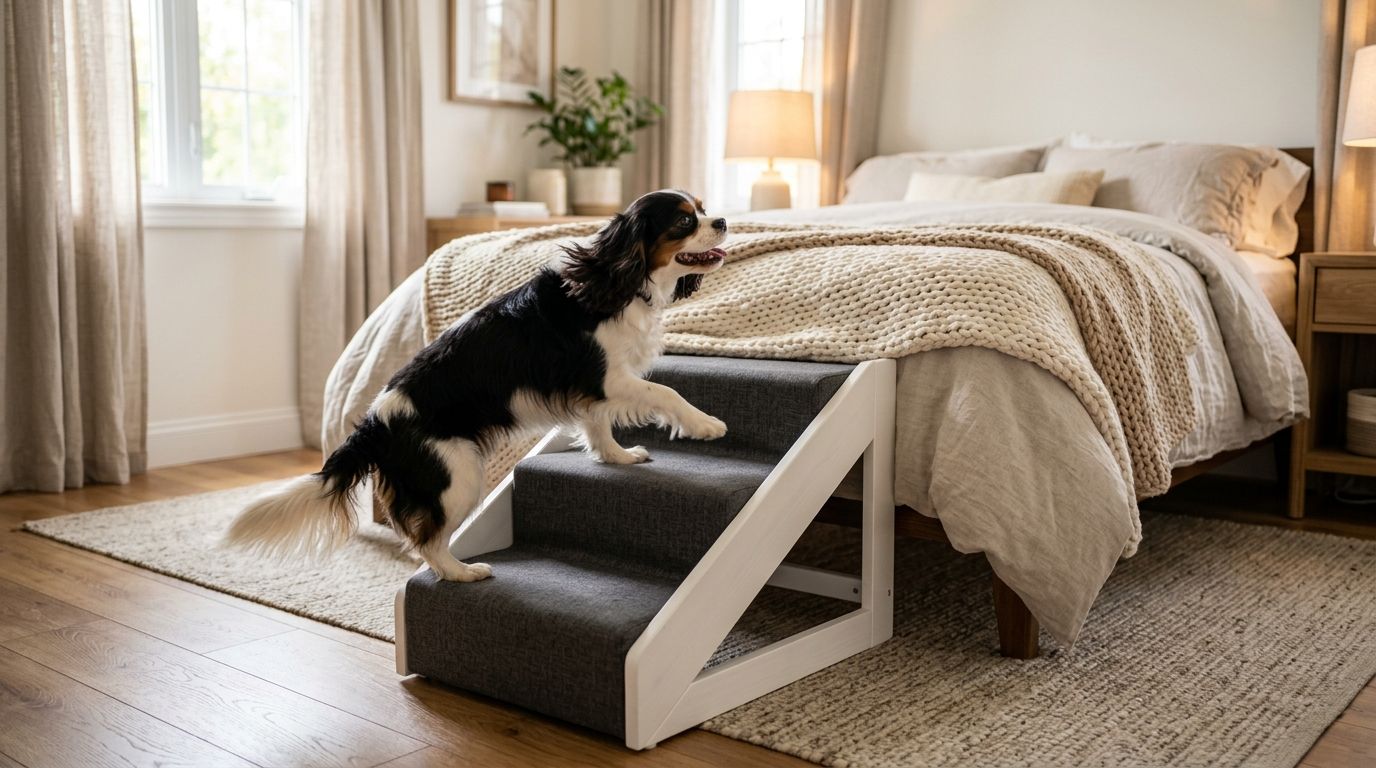
Dog stairs solve one problem: getting a dog with short legs, sore joints, or extra pounds onto a bed or couch without a hard jump that stresses hips and knees. This guide ranks the main types of dog stairs sold in 2026, tells you which one fits your furniture and your dog's build, and flags the real trade-offs of each.
- Best overall: foldable foam dog stairs — joint-friendly and easy to store under a bed.
- Best for large or heavy dogs: upholstered wood-frame stairs built for repeated daily use.
- Best budget option: molded plastic dog stairs, simplest to wipe down and store.
- Best for multiple furniture heights: adjustable telescoping dog stairs.
- Best for senior dogs: wide, low-rise carpeted stairs with a shallow climb angle.
Why this matters
A dog that leaps off a couch or bed lands on its front legs and absorbs the full impact through its shoulders and wrists — repeated over months, that's how orthopedic problems start in small breeds and senior dogs of any size. The best dog stairs for beds and couches cut that impact by breaking the descent into steps a dog's joints can actually manage, and the right choice depends more on your dog's weight and age than on furniture height alone.
Most bed and couch platforms in the US sit between 18 and 24 inches off the floor, which is why nearly every dog stairs product on the market ships as a 3-to-5-step design. Fewer steps means a steeper climb angle; more steps means a gentler one but a bigger footprint in the bedroom.
What makes the best dog stairs
- Step rise — lower rise per step (commonly 4 to 7 inches) means less strain per stride, which matters most for dogs under 15 lbs or over 8 years old
- Weight capacity — foam models typically top out around 50-75 lbs; wood-frame and upholstered builds often rate to 100+ lbs
- Tread width and traction — a tread under 8 inches deep is unstable for anything bigger than a toy breed
- Non-slip base — rubberized feet or a wide footprint keep the unit from sliding on hardwood or tile
- Storage and portability — folding foam collapses flat; wood stairs stay put permanently
- Washable cover — removable, machine-washable covers matter more than people expect once a dog starts using stairs daily
Dog stairs at a glance
| Type | Best for | Standout feature | Key limitation |
|---|---|---|---|
| Foldable foam stairs | Small-to-medium dogs, general use | Cushioned tread absorbs impact | Loses shape faster under heavy daily weight |
| Upholstered wood-frame stairs | Large or heavy dogs | Rigid frame holds weight without flexing | Bulky, doesn't fold or tuck away |
| Molded plastic stairs | Budget-conscious buyers | Wipes clean in seconds, no fabric to wash | Harder tread, less joint cushioning |
| Adjustable telescoping stairs | Multiple furniture heights | Extends or retracts to match bed vs. couch | More moving parts, more to break |
| Wide low-rise carpeted stairs | Senior dogs, mobility issues | Shallow climb angle, extra-wide tread | Larger floor footprint |
1. Foldable foam dog stairs: best overall for everyday use
Foam stairs are a solid-core foam wedge cut into 3 to 4 steps and wrapped in a fabric cover, usually collapsing flat for storage under a bed. They're the default recommendation for most healthy dogs under 60 lbs because the foam gives slightly under each paw, which is gentler on aging joints than a hard tread.
Foam dog stairs pros:
- Cushioned surface reduces joint impact compared to rigid steps
- Folds flat for storage in apartments and smaller bedrooms
- Lightweight enough to move between rooms
Foam dog stairs cons:
- Foam compresses and softens over months of daily use by a heavier dog
- Covers need regular washing once a dog tracks in dirt or sheds on the tread
- Not rated for dogs pushing past 60-75 lbs
Best for: small-to-medium dogs and owners who want one set of stairs that folds away. Verdict: Buy.
2. Upholstered wood-frame stairs: best for large or heavy dogs
Wood-frame stairs use a solid internal frame under upholstered padding, giving them a stable base that doesn't flex under weight the way foam-only stairs can. They read as furniture, which matters if the stairs are staying next to a bed permanently.
Wood-frame stairs pros:
- Rigid frame supports dogs up to and past 100 lbs without sagging
- Doesn't compress or lose shape the way foam does over time
- Matches upholstered furniture better for a permanent placement
Wood-frame stairs cons:
- Doesn't fold, so it occupies floor space permanently
- Heavier to move if you rearrange furniture often
- Costs more to produce than foam or plastic, which usually shows up in price
Best for: large-breed dogs and owners who want one fixed set of stairs by the bed. Verdict: Buy if you have a large dog and a permanent spot for it.
3. Molded plastic dog stairs: best budget option
Plastic stairs are injection-molded steps, sometimes with a textured or rubberized tread insert for grip. They're the simplest construction on this list and the easiest to keep clean, since there's no fabric to absorb odor or shedding.
Plastic stairs pros:
- Wipes clean with a damp cloth in seconds
- No fabric cover to wash or replace
- Generally the lightest option to carry between rooms
Plastic stairs cons:
- Hard tread offers no cushioning, which matters for arthritic dogs
- Can feel less stable on slick floors without a textured base
- Aesthetically the least furniture-like option
Best for: owners who prioritize easy cleaning over cushioning, and dogs without joint issues. Verdict: Buy for healthy dogs on a budget; Skip for senior dogs with arthritis.
4. Adjustable telescoping dog stairs: best for multiple furniture heights
These use a telescoping or slide-out mechanism to extend the number of usable steps, letting one unit work for an 18-inch bed and a 24-inch couch by adjusting length. They solve the problem of owning two different furniture heights without buying two sets of stairs.
Telescoping stairs pros:
- One unit adjusts to different furniture heights
- Useful in households with more than one piece of tall furniture
- Often stores more compactly than a fixed multi-step unit
Telescoping stairs cons:
- More moving parts means more that can loosen or break over 2026's typical daily-use cycle
- Usually pricier than a fixed foam or plastic set
- Adjustment mechanism can wobble if not locked correctly each time
Best for: households with a tall bed and a lower couch that both need stairs. Verdict: Buy if you genuinely need one unit for two heights; Hold if a fixed set covers your one piece of furniture.
5. Wide low-rise carpeted stairs: best for senior dogs and mobility issues
These trade step count for width and a shallow rise, often running 4 to 5 steps with a wider-than-usual tread depth so an unsteady dog has more surface to plant each paw. If your dog hesitates before the top step, the rise is too steep for its joints — that's the exact problem this style is built to fix.
Low-rise carpeted stairs pros:
- Shallowest climb angle of any style, easiest on arthritic hips and knees
- Wide tread gives unsteady dogs more room to place each paw
- Carpeted surface adds grip beyond what foam alone provides
Low-rise carpeted stairs cons:
- Larger footprint takes up more floor space than a compact foam unit
- Carpet cover needs vacuuming or occasional deep cleaning
- Overkill for young, healthy dogs with no mobility concerns
Best for: senior dogs, post-surgery recovery, and dogs with diagnosed hip or knee conditions. Verdict: Buy for any dog showing hesitation on standard stairs.
“If your dog hesitates before the top step, the rise is too steep for its joints.”
How this list was ranked
Each type was scored against the six criteria above — step rise, weight capacity, tread width, base stability, storage, and washability — then matched to the use case where it performs best rather than forced into a single overall ranking. That's why five different styles each hold the top spot for a distinct situation instead of competing head-to-head for one crown.
Shop dog stairs and ramps
Browse dog stairs, orthopedic beds, and joint-support gear for beds and couches.
Which dog stairs should you choose?
For most healthy dogs under 60 lbs, foldable foam stairs are the right first purchase in 2026 — they're the most joint-friendly option that still folds away when guests visit. If your dog is large-breed or over 60 lbs, move straight to upholstered wood-frame stairs since foam alone won't hold that weight without sagging over time.
Senior dogs or anything recovering from joint surgery need the wide, low-rise carpeted design regardless of size — the shallow climb angle matters more than weight capacity at that stage. If your dog is already dealing with joint strain, pairing stairs with orthopedic dog beds for large dogs closes the loop between getting onto furniture and resting comfortably once there.
Smaller living spaces change the calculation too — if floor space is tight, check how stairs fit alongside space-saving options like dog crate furniture for small apartments before committing to a permanent wood-frame unit.
FAQ
What's the best dog stairs for beds and couches in 2026?
Foldable foam dog stairs are the best overall pick for most healthy dogs under 60 lbs because they cushion each step and fold flat for storage. Large or heavy dogs do better with upholstered wood-frame stairs, and senior dogs need a wide, low-rise carpeted design.
Are dog stairs better than a ramp?
Stairs work better in tight spaces since they take up less floor length than a ramp reaching the same height. Ramps are generally gentler for dogs with severe joint pain or spinal issues, since there's no discrete step to negotiate.
How many steps do dog stairs need for a bed?
Most beds sit 18 to 24 inches off the floor, which is why 3-to-5-step designs cover the vast majority of bed and couch heights. A shorter dog or an arthritic dog benefits from the higher step count since each individual rise is shallower.
Can dog stairs hold a large dog's weight?
Upholstered wood-frame stairs are built for dogs up to and past 100 lbs, while foam-only stairs typically max out around 50-75 lbs. Check the frame construction, not just the cover material, before buying for a large breed.
Do dog stairs help with hip dysplasia?
Yes — breaking a jump into shallow steps reduces the joint impact that aggravates hip dysplasia and arthritis. Wide, low-rise carpeted stairs are the specific style built for dogs with diagnosed joint conditions.
Are foam or plastic dog stairs easier to clean?
Molded plastic stairs are easier to clean since they wipe down with a damp cloth and have no fabric cover. Foam stairs need their cover washed periodically, which matters more in households with heavy shedding or muddy paws.
Do dog stairs work for both beds and couches?
A fixed-height set works fine if your bed and couch are similar heights, but adjustable telescoping stairs solve the problem when the two pieces of furniture differ significantly. Measure both before buying a single fixed unit.
One last thing
The detail most owners miss: a dog that already jumps confidently onto furniture will often refuse to use stairs at first, not because the stairs are wrong but because the behavior has to be retrained with treats at each step. Give it a week of short, rewarded practice sessions before deciding a product doesn't work — the stairs themselves are rarely the problem in the first few days.