Elevated dog bowls promise better posture and less mess for big dogs, but the category splits hard on materials, height, and one real safety debate. Best overall: an adjustable-height stainless steel stand. Best for large and giant breeds: a heavy-duty double-wall wood stand with a wide base. Best budget option: a two-tier plastic stand — with one caveat. This guide ranks the elevated dog bowl types worth buying for big dogs in 2026, and flags the one large-breed feeding mistake that shows up in veterinary research.
- An adjustable-height stainless steel stand is the best overall pick for large dogs that are still growing or shared across multiple sizes.
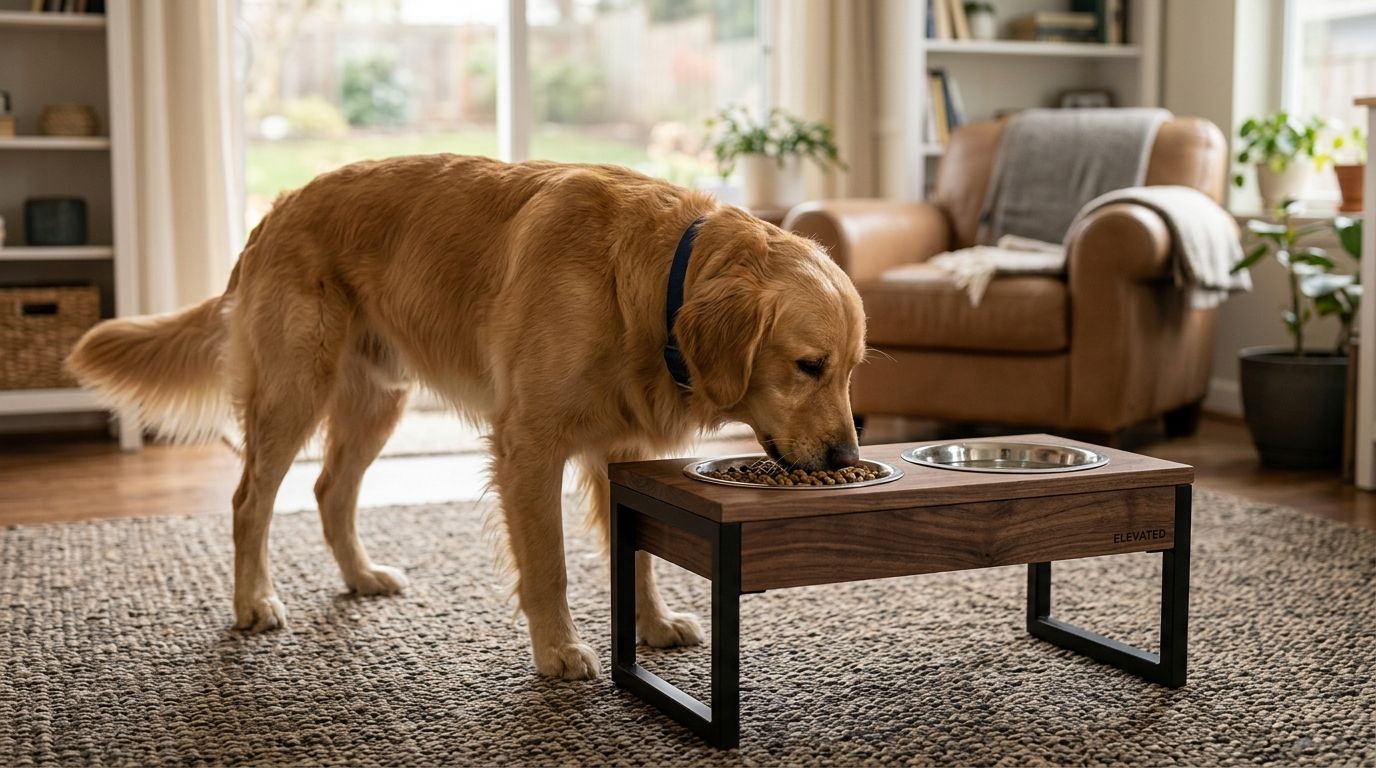
- Heavy-duty double-wall wood stands win for giant breeds because the wide base resists tipping during aggressive drinking.
- Two-tier plastic stands are the best elevated dog bowls for large dogs on a budget, but they're the least stable option.
- Large and giant breeds with a history of bloat or a deep chest should talk to a vet before switching to any raised feeder.
- Stainless steel with a non-slip silicone base is the best pick for older dogs with arthritis or hip dysplasia.
Why this matters
Big dogs bend their necks farther to reach a bowl on the floor, and that angle gets harder on the shoulders and spine as a dog ages or develops joint issues. An elevated bowl brings the food and water up to a more natural head position, which cuts down on the neck-craning that aggravates arthritis and hip dysplasia — the same conditions covered in orthopedic dog beds for large breeds.
The catch: a 2000 study out of Purdue University (Glickman et al., published in the Journal of the American Veterinary Medical Association) found that raised feeders were linked to a higher incidence of gastric dilatation-volvulus (bloat) in large and giant breed dogs, particularly deep-chested breeds like Great Danes and German Shepherds. That research is over two decades old and hasn't settled the debate — some vets still recommend elevated feeding for joint relief — but it's the reason this guide doesn't crown a single winner without caveats. You can browse the full range of feeding accessories on Shop and Bark if you want to compare bowl materials side by side before you commit.
What makes the best elevated dog bowl for large dogs
- Height matched to the dog's shoulder, not a fixed one-size stand — large breeds typically need 12 to 18 inches of lift, versus 8 to 12 inches for medium dogs.
- A wide, weighted base that won't tip when an 80-plus pound dog leans into the bowl or drinks fast.
- Bowl material that resists bacteria and scratching — stainless steel and ceramic outperform plastic here.
- Non-slip feet or a rubberized base so the whole stand doesn't skate across hardwood or tile.
- Adjustable or swappable height settings so the stand keeps working as a puppy grows into an adult.
- Easy-clean bowls that lift out of the stand instead of bowls bonded to the frame.
Elevated dog bowls for large dogs at a glance
| Item | Best for | Standout feature | Key limitation |
|---|---|---|---|
| Adjustable-height stainless steel stand | Growing and multi-dog households | Height adjusts as the dog grows | Legs can wobble on uneven floors |
| Heavy-duty double-wall wood stand | Large and giant breeds | Wide base resists tipping | Bulky, hard to move between rooms |
| Two-tier plastic stand | Budget-conscious owners | Lightweight and easy to store | Least stable option for big dogs |
| Stainless steel with non-slip silicone base | Dogs with joint pain or arthritis | Silicone base grips tile and hardwood | Bowls sit fixed at one height |
| Wide double-bowl elevated stand | Multi-dog large-breed households | Two bowls at equal height, side by side | Takes up significant floor space |
1. Adjustable-height stainless steel stand: best overall for large dogs
This stand uses notched or telescoping legs so the bowl height changes as a puppy grows or when the stand gets handed down to a smaller dog in the house. Stainless steel bowls resist scratching and don't hold bacteria the way plastic does over repeated washes, which matters for dogs that eat wet food daily.
Adjustable-height stand pros:
- Height adjusts across multiple growth stages or dog sizes
- Stainless steel bowls are dishwasher-safe and scratch-resistant
- Works for both food and water in a single frame
Adjustable-height stand cons:
- Thinner legs can wobble on uneven or carpeted floors
- Not the most stable choice for a fast-drinking giant breed
Best for: large dogs that are still growing, or households with more than one dog size.
Verdict: Buy — this is the safest default pick for most large-breed owners in 2026.
2. Heavy-duty double-wall wood stand: best for large and giant breeds
A wide, low-center-of-gravity wood frame holds up better than metal or plastic when a 90-plus pound dog leans into the bowl or shoves it while eating. The double-wall construction adds weight at the base specifically to resist tipping, which is the main failure point of lighter stands with giant breeds.
Double-wall wood stand pros:
- Wide base resists tipping under an aggressive drinker
- Solid construction holds up to daily use by 80+ pound dogs
- Doesn't skid across hardwood the way lighter stands do
Double-wall wood stand cons:
- Bulky and hard to relocate between rooms
- Fixed height means it won't adjust as a puppy grows
Best for: Great Danes, Mastiffs, and other giant breeds where stability outweighs portability.
Verdict: Buy — check with a vet first if the dog has a history of bloat, per the Purdue research above.
3. Two-tier plastic stand: best budget option
A molded plastic frame with two bowl slots costs the least of any option in this category and stores flat when not in use. It works fine for a calm eater but is the first stand to slide or tip when a large dog eats with any force.
Two-tier plastic stand pros:
- Lightest and cheapest option in the category
- Easy to wipe down and store
- Fine for moderate-size large breeds that eat calmly
Two-tier plastic stand cons:
- Least stable option for dogs over 70 pounds
- Plastic bowls scratch and hold odor faster than stainless steel
- Not built for daily use by a giant breed
Best for: owners of moderate-size large dogs who want a low-cost trial before upgrading.
Verdict: Hold — fine as a starter, but plan to upgrade if the dog is over 70 pounds or eats aggressively.
4. Stainless steel with non-slip silicone base: best for joint pain and arthritis
This stand pairs a stainless steel bowl with a molded silicone base instead of legs, keeping the whole unit low, wide, and grippy on hardwood or tile. The fixed height is usually set lower than a full stand, which suits senior dogs that need a gentle lift rather than a dramatic one.
Non-slip silicone stand pros:
- Silicone base grips smooth floors better than any leg-style stand
- Low profile reduces tipping risk almost entirely
- Stainless bowls resist bacteria buildup for daily wet food
Non-slip silicone stand cons:
- Fixed height doesn't adjust for growing dogs
- Lower lift than tall stands, so less benefit for very large breeds
Best for: senior large dogs with arthritis or hip dysplasia that need stability more than height.
Verdict: Buy — pairs naturally with a supportive bed from the orthopedic dog beds for large breeds lineup for dogs managing joint pain.
5. Wide double-bowl elevated stand: best for multi-dog large-breed households
Built with two bowl slots at equal height in one wide frame, this stand lets two large dogs eat side by side without one bowl sitting lower or wobblier than the other. It solves a specific problem single-bowl stands don't: uneven feeding setups when you own more than one big dog.
Double-bowl stand pros:
- Both bowls sit at matched height, so no dog gets an awkward angle
- Wide footprint adds stability for two dogs eating at once
- Cuts down on one dog crowding the other's bowl
Double-bowl stand cons:
- Takes up significant floor space in smaller kitchens
- Fixed spacing doesn't work if your dogs are very different sizes
Best for: households feeding two large or giant breeds at the same time.
Verdict: Buy — the clearest fix for multi-dog feeding conflicts among big dogs.
Compare feeding and joint-care picks
Browse bowls, beds, and grooming gear built for large breeds.
How this list was ranked
Each stand was scored against the six criteria above: height range, base stability, bowl material, non-slip grip, adjustability, and cleaning ease. No option won on every criterion — the plastic stand loses on stability, the wood stand loses on portability, and the silicone base loses on adjustability. That's why five different items own five different "best for" slots instead of one bowl sweeping every category.
Which elevated dog bowl should you choose?
If you're feeding one large dog that's still growing, the adjustable-height stainless steel stand is the safest default for 2026. Giant breed owners should lean toward the heavy-duty double-wall wood stand for stability, but talk to a vet first if bloat risk is a concern in that breed line. Senior dogs with joint pain do best with the non-slip silicone base model, and multi-dog large-breed households should skip straight to the wide double-bowl stand.
FAQ
What's the best elevated dog bowl for large dogs?
An adjustable-height stainless steel stand is the best overall pick for large dogs in 2026 because it adjusts as the dog grows and resists bacteria buildup. Giant breeds with stability concerns do better with a heavy-duty double-wall wood stand instead.
Are elevated dog bowls bad for large breeds?
A Purdue University study published in JAVMA linked raised feeders to a higher incidence of bloat (gastric dilatation-volvulus) in large and giant, deep-chested breeds. Talk to a vet before switching a bloat-prone breed to an elevated feeder.
How tall should an elevated dog bowl be for a large dog?
Large breeds generally need 12 to 18 inches of lift, compared to 8 to 12 inches for medium dogs. The bowl should sit roughly at the dog's chest or elbow height, not the neck.
Is stainless steel or ceramic better for elevated dog bowls?
Stainless steel resists scratching and bacteria buildup better than ceramic or plastic over daily use. Ceramic is fine for water-only bowls but chips more easily with rough daily handling.
Do elevated dog bowls help with arthritis in large dogs?
Yes, raising the bowl reduces the neck and shoulder angle a dog uses to eat, which eases strain for dogs with arthritis or hip dysplasia. A low, wide stand with a non-slip base gives that benefit without the tipping risk of a tall stand.
Can two large dogs share one elevated feeding stand?
A wide double-bowl stand with two equal-height slots works for two large dogs eating side by side. Single-bowl stands aren't built for this and often lead to one dog crowding the other.
Do plastic elevated dog bowls work for large dogs?
Plastic stands work for moderate-size large dogs with a calm eating style but are the least stable option once a dog passes about 70 pounds. Stainless steel or wood stands hold up better under daily aggressive eating.
One last thing
The most overlooked detail in this category isn't the bowl material — it's that the Purdue bloat research is over two decades old and still hasn't been overturned or replaced by newer data specific to elevated bowls. If you own a deep-chested giant breed, that single unresolved question matters more in 2026 than any spec on the stand itself, so a five-minute conversation with your vet before buying is worth more than any review on this page.