Bored dogs bark more, chew furniture, and pace at 3pm on a Tuesday — the fix in 2026 is matching the toy type to the boredom trigger, not just buying whatever ranks first on Amazon.
- Treat-dispensing rubber toys are the best overall pick for solo problem-solving dogs in 2026.
- Snuffle mats win for food-motivated dogs that need scent work, not chewing.
- Automatic treat-dispensing balls cover the 8-to-5 workday gap better than static toys.
- Puzzle slide-and-reveal games are the lowest-impact option for older or joint-sensitive dogs.
- Flirt poles need owner involvement, so they don't solve boredom during alone time.
Why this matters
A dog left with nothing to do for six or eight hours doesn't relax — it escalates. Destructive chewing, excessive barking, and pacing are the three most commonly cited signs of under-stimulation in adult dogs, and none of them respond to a toy that sits untouched on the floor after day two.
The right interactive dog toy category depends on what's actually driving the boredom: a nose that wants scent work, jaws that want resistance, or a brain that wants a puzzle to solve. Shop and Bark stocks toys across all three categories, and picking the wrong one is the single biggest reason owners think "my dog doesn't like toys" when the real issue is a category mismatch.
Best overall, best for scent work, best budget: the quick verdict
Best overall: treat-dispensing rubber chew toys. Best for scent-driven dogs: snuffle mats. Best for workday alone time: automatic treat-dispensing balls. Best low-impact option for seniors: puzzle slide-and-reveal games. Best for high-energy dogs who need owner involvement: flirt poles and tug-interactive toys.
What makes the best interactive dog toys for bored dogs
- Difficulty scales — the toy should get harder as the dog gets better at it, not stay static
- Durability matched to jaw strength — a toy destroyed in 10 minutes isn't interactive, it's a snack
- Independent play capability — the best options work without a human refilling them every five minutes
- Cleanability — anything holding food residue needs to survive a dishwasher or hand wash without falling apart
- Safety at rest — pieces small enough to swallow, or motors that don't pinch, are disqualifying if missing
- Actual engagement time — a toy a dog abandons after one session doesn't count, no matter how clever the design
At a glance: interactive toy categories compared
| Category | Best for | Standout feature | Key limitation |
|---|---|---|---|
| Treat-dispensing rubber chew toys | Solo problem-solving | Withstands heavy chewing while dispensing food | Needs regular refilling to stay interesting |
| Snuffle mats | Scent-driven dogs | Mimics foraging behavior | Requires hand-washing, not machine-safe for all fabrics |
| Puzzle slide-and-reveal games | Low-impact mental work | No chewing or jumping required | Not durable against destructive chewers |
| Automatic treat-dispensing balls | Workday alone time | Runs unsupervised for extended stretches | Battery-dependent, needs monitoring at first |
| Flirt poles / tug toys | High-energy dogs, owner-involved | Burns physical energy fast | Doesn't solve boredom during actual alone time |
1. Treat-dispensing rubber chew toys: best interactive dog toy for solo problem-solving
These are the rubber, hollow-core toys stuffed with kibble, peanut butter, or treats that a dog has to work at with tongue and teeth to empty. They're the closest thing to a universal starting point because most dogs, regardless of breed or energy level, will engage with food inside rubber before trying anything else.
Treat-dispensing rubber toy pros:
- Durable enough for most chewers, including many heavy-jawed breeds
- Works for solo play with zero supervision needed once introduced
- Freezing the stuffed toy extends engagement time significantly
- Dishwasher-safe on most models, which matters for hygiene
Treat-dispensing rubber toy cons:
- Extreme chewers can still damage softer rubber over time
- Needs manual refilling, so it's not a full workday solution on its own
- Loses appeal fast if the same filling is used every time
Verdict: Buy. This is the category to start with before spending on anything more specialized, and Shop and Bark's toy selection includes several stuffable rubber options built for daily rotation.
2. Snuffle mats: best interactive dog toy for food-motivated, scent-driven dogs
A snuffle mat is a textured fabric mat with fleece strips or pockets where treats get hidden, forcing the dog to sniff and forage instead of just eating from a bowl. Scent work is mentally tiring in a way that physical exercise isn't, which makes this category effective for dogs that seem restless even after a walk.
Snuffle mat pros:
- Slows down fast eaters as a side benefit
- Taps into natural foraging instinct rather than fighting it
- Works well for dogs with limited mobility since it requires no jumping
Snuffle mat cons:
- Hand-washing only for most models, which adds upkeep
- Some dogs shake the mat instead of sniffing it, defeating the purpose
- Not built to survive chewing if a dog decides to bite instead of sniff
Verdict: Buy for any dog that's more nose-driven than jaw-driven — check behavior first, not breed assumptions.
3. Puzzle slide-and-reveal games: best interactive dog toy for low-impact mental work
These are the wooden or plastic boards with sliding covers, flip lids, or spinning discs hiding treats underneath. No chewing, no jumping, no running — just problem-solving with paws and nose. That makes this the category to reach for with senior dogs or anyone recovering from joint issues who still needs enrichment.
Puzzle game pros:
- Zero physical strain, ideal for dogs with mobility limits
- Difficulty adjusts by hiding treats under more or fewer covers
- Good for building focus in dogs that get overstimulated easily
Puzzle game cons:
- Not chew-resistant, so it's the wrong pick for destructive chewers
- Smaller pieces can be a choking risk if a dog decides to gnaw the board
- Some dogs solve the puzzle in under a minute and lose interest fast
Verdict: Hold for destructive chewers, Buy for seniors or dogs recovering from injury.
4. Automatic treat-dispensing balls: best interactive dog toy for workday alone time
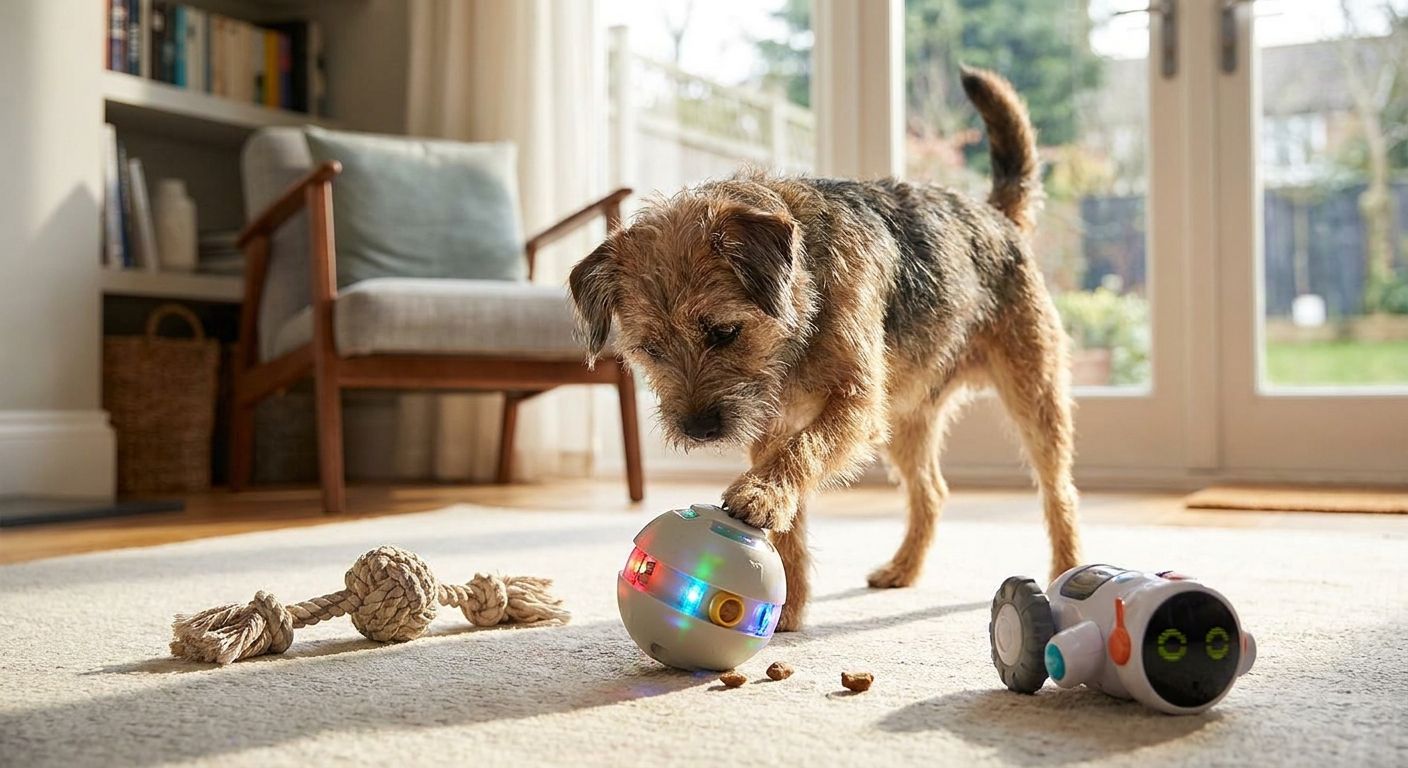
Motion-activated or programmable balls that release treats as the dog rolls or nudges them. This is the category built specifically for the six-to-eight-hour gap between when you leave for work and when you get home, which none of the other categories on this list are designed to cover.
Automatic dispenser pros:
- Keeps working without a human refilling it constantly
- Rolling motion adds physical activity on top of mental engagement
- Some models let you adjust dispensing frequency as the dog improves
Automatic dispenser cons:
- Battery life varies, and a dead battery means a silent, boring toy
- Needs supervised introduction first — don't leave a dog alone with it on day one
- Higher price point than static rubber or fabric options
Verdict: Buy for dogs regularly left alone for long stretches, after a supervised trial run.
5. Flirt poles and tug-interactive toys: best interactive dog toy for high-energy, owner-involved play
A flirt pole is essentially a giant cat toy for dogs — a pole with a lure on a rope that the owner moves to trigger chase and pounce behavior. It's the fastest way to burn physical energy in a small space, but it requires an owner on the other end of the rope.
Flirt pole pros:
- Burns high energy in 10 to 15 minutes, faster than most walks
- Builds impulse control when paired with "drop it" and "wait" cues
- Cheap to replace compared to electronic toy categories
Flirt pole cons:
- Does nothing for boredom during actual alone time, since it requires a human
- Overuse can encourage jumping and mouthing if not paired with training
- Not appropriate for dogs with joint issues due to the sudden pivots
Verdict: Buy as a supplement, not a standalone solution — pair it with a solo toy from this list for full coverage.
Browse interactive dog toys at Shop and Bark
Compare chew-resistant, scent-based, and puzzle toy options in one place.
How this ranking was built
Each category was scored against the six criteria above: difficulty scaling, durability against jaw strength, ability to support independent play, cleanability, safety at rest, and actual measured engagement time rather than novelty on day one. Categories that only scored well on novelty — impressive-looking toys a dog ignores after a week — were downgraded regardless of price or design.
Which interactive dog toy should you choose in 2026?
Start with a treat-dispensing rubber chew toy if you're only buying one thing this year — it covers the widest range of dogs and doubles as a frozen treat option in warmer months. Add a snuffle mat if your dog seems restless even after exercise, since that's usually a scent-work gap, not an energy gap. If you're regularly out of the house for a full workday, an automatic treat-dispensing ball is worth the higher cost because none of the static options solve for unsupervised time the same way.
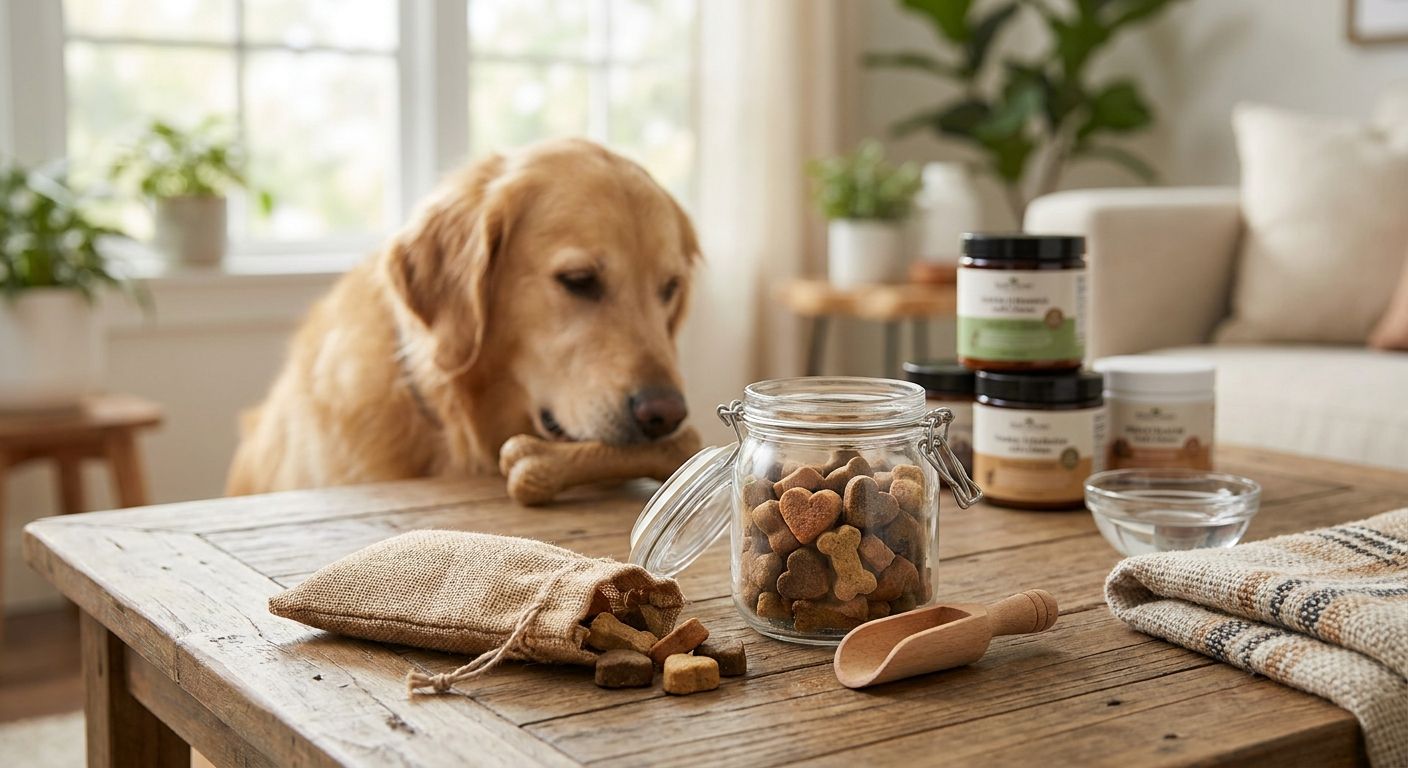
Dogs recovering from joint issues or aging into lower-impact play do best with puzzle slide-and-reveal games, and high-energy dogs benefit from adding a flirt pole session on top of whichever solo toy you pick — trainers commonly recommend rotating toys every one to two weeks to prevent a dog from habituating to the same puzzle. If boredom is showing up as anxiety rather than destructive chewing, it's also worth checking calming chews for dogs with anxiety alongside a new toy, since the two problems often overlap.
“A toy a dog ignores after two days isn't interactive, it's decoration.”
FAQ
What are the best interactive dog toys for bored dogs in 2026?
Treat-dispensing rubber chew toys rank best overall in 2026 because they work across the widest range of dogs and support unsupervised solo play. Snuffle mats and puzzle games are better matches for scent-driven or low-mobility dogs specifically.
How long should an interactive dog toy hold a dog's attention?
A well-matched interactive toy should hold engagement for at least 10 to 15 minutes per session, longer for frozen stuffed rubber toys. Anything abandoned within a minute or two is usually the wrong category for that dog, not a defective toy.
Are snuffle mats or puzzle toys better for bored dogs?
Snuffle mats suit food-motivated dogs that want to sniff and forage, while puzzle slide-and-reveal games suit dogs that need low-impact mental work without jumping or chewing. Pick based on whether your dog's boredom shows up as nose-driven restlessness or general understimulation.
Can automatic treat-dispensing toys be left with a dog all day?
Automatic treat-dispensing balls can run unsupervised for extended stretches, but only after a supervised trial run to confirm the dog doesn't chew the housing or get frustrated. Battery-powered toys should be checked regularly since a dead battery turns an interactive toy into a dead weight on the floor.
Do interactive toys actually stop destructive chewing?
Interactive toys reduce destructive chewing when they match the dog's jaw strength and get rotated regularly, but they don't fix chewing driven by anxiety rather than boredom. If chewing continues alongside pacing or excessive barking, anxiety is a more likely root cause than simple boredom.
How often should dog toys be rotated to prevent boredom?
Rotating toys every one to two weeks is the commonly cited window before dogs habituate to a puzzle or chew toy and lose interest. Keeping two or three categories in rotation, rather than one toy on repeat, extends engagement across 2026 and beyond.
Are flirt poles safe for all dogs?
Flirt poles work well for high-energy dogs without joint problems, but the sudden pivots and lunges make them a poor fit for dogs with mobility limits or recovering from injury. Puzzle slide-and-reveal games are the safer low-impact alternative for those dogs.
What's the difference between a chew toy and an interactive toy?
A chew toy is passive — the dog gnaws it and nothing changes. An interactive toy requires the dog to solve a problem, dispense a reward, or engage in scent work, which is what actually addresses boredom rather than just occupying teeth.
One last thing
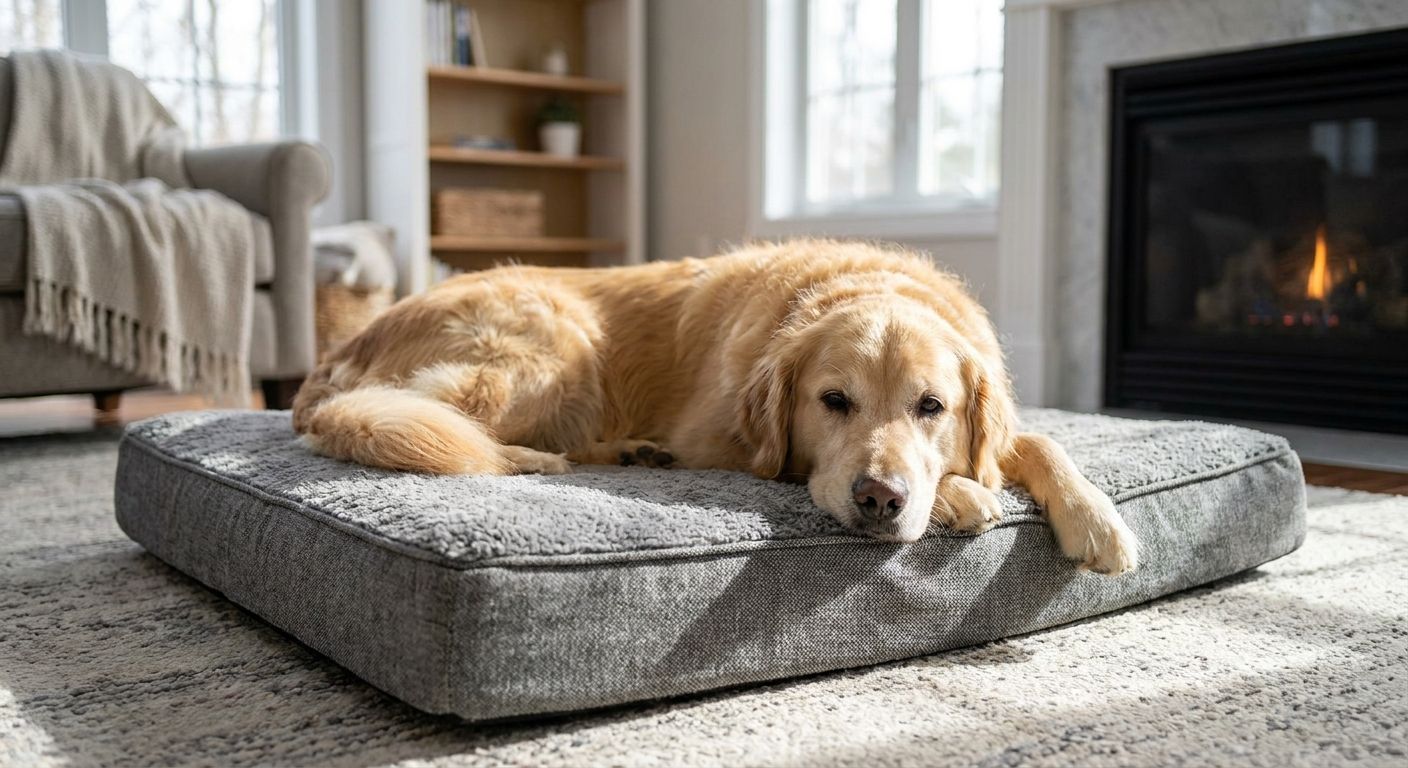
The biggest mistake in 2026 isn't picking the wrong toy category — it's picking one toy and never rotating it. Dogs habituate to a single puzzle or chew toy faster than owners expect, which is why keeping two or three categories on a one-to-two-week rotation outperforms any single "best" toy on this list. If your dog is also showing signs of low-impact needs from age or joint strain, pairing an enrichment toy with orthopedic dog beds for large dogs covers both the mental and physical side of the same problem.