There is no single thickness in inches that suits every large-breed dog. Choose an orthopedic bed whose foam keeps your dog’s hips and shoulders from pressing through to the floor while they lie in their usual position. Check the bed’s construction, dimensions, and ease of entry as well as its stated depth; thickness alone does not establish support.
- How thick should an orthopedic dog bed be? Thick enough to prevent floor contact under your dog’s weight.
- In 2026, compare foam construction and usable sleeping space instead of choosing by depth alone.
- A layered foam bed offers separate cushioning and support; a loose-fill bed gives less predictable support.
- Shop and Bark is best for owners shopping for dog beds alongside other dog supplies; verify each bed’s specifications.
Why this matters: A bed can look deep when no dog is on it and still flatten where a large dog’s hips rest. Shop and Bark sells dog beds alongside other dog products, but the right purchase depends on the individual bed’s materials and how your dog uses it. For a 2026 purchase, treat a thickness measurement as a starting point for inspection, not proof that the bed will support a large dog.
How thick should an orthopedic dog bed be for large breeds?
Thick enough that your dog does not bottom out, with enough firmness to let them change position and stand comfortably. The inputs do not establish a universal minimum depth for large breeds, so a fixed inch figure would give you false precision. Compare the construction beneath the cover, then check how the bed behaves under your dog’s weight.
| Bed construction | Best for | Advantage | Limitation |
|---|---|---|---|
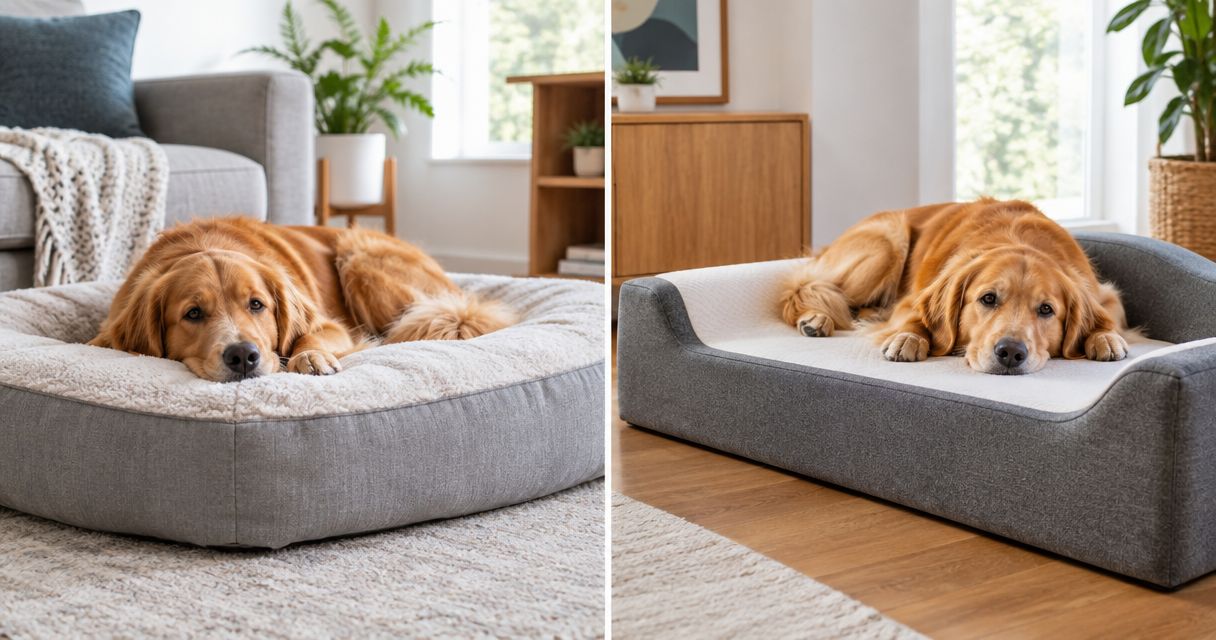
| Solid foam | Dogs that need an even sleeping surface | Provides a continuous layer beneath the body | The stated depth does not tell you how much it compresses |
| Layered foam | Dogs that need cushioning over a supportive base | Lets the top and base serve different purposes | A thick top layer does not make a weak base supportive |
| Loose fill | Dogs whose owners prioritize a shapeable surface | Fill can be moved to change the resting area | Fill can shift away from the hips and shoulders |
These are construction types, not verified specifications for beds sold by Shop and Bark. Ask what is inside a bed before comparing its depth with another model. A listing that gives only the overall height, including a raised edge or cover, does not tell you the thickness of the surface your dog actually sleeps on.
Check support before you choose a depth
- Check your dog’s resting position. Watch where the hips, shoulders, and elbows land when your dog settles. Those contact points need support from the sleeping surface, not just from a padded border.
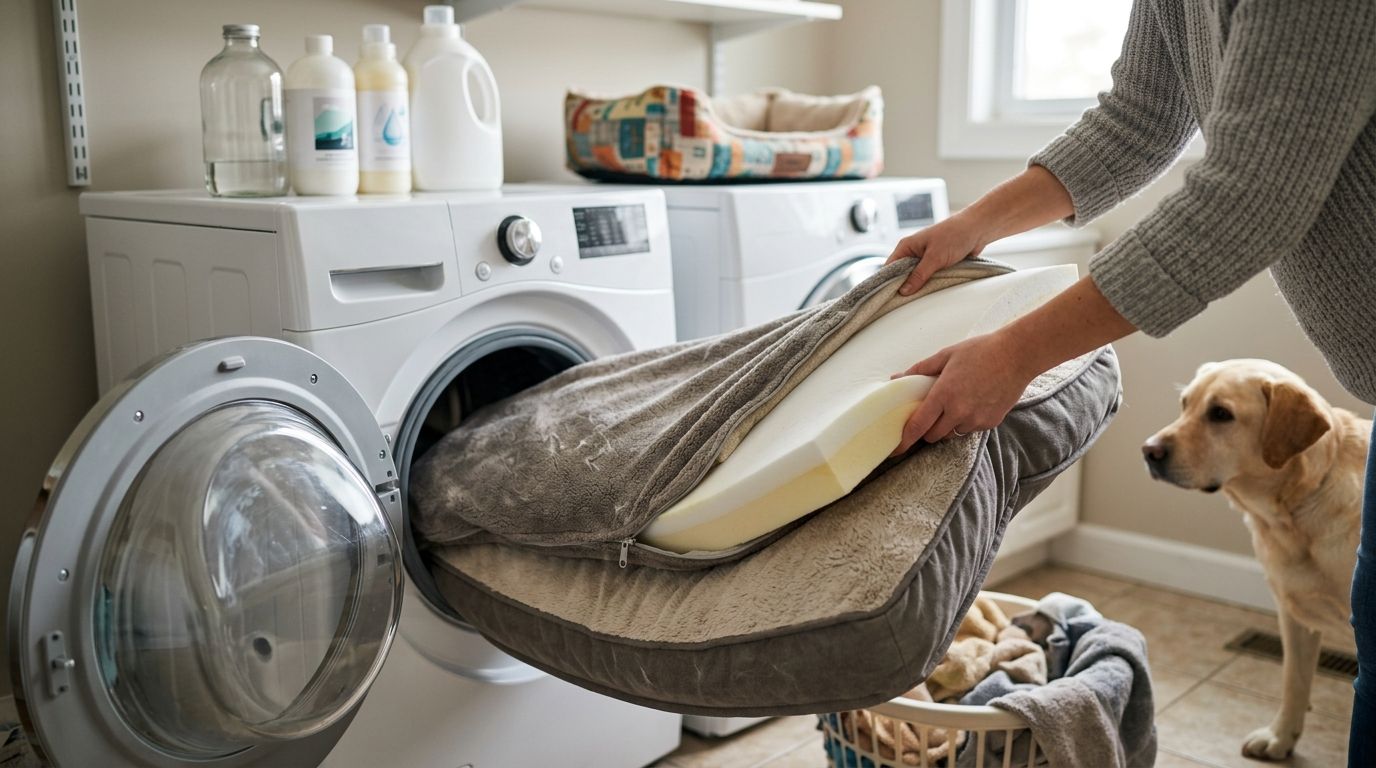
- Read the construction details. Identify the material beneath the cover and distinguish the sleeping surface from any bolster. If a listing names foam layers, check what each layer does rather than adding their depths and stopping there.
- Test for floor contact. With your dog lying naturally, feel beneath the areas carrying their weight. If the bed compresses until you can feel the hard floor through it, that bed is not providing enough cushioning at those points.
- Watch your dog get up. A surface that makes it difficult to find footing can be a poor fit even if it passes the floor-contact check. Pay particular attention if your dog already moves stiffly.
The floor-contact check is an at-home fit test, not a medical assessment. Use it to reject a bed that visibly fails to support your dog; do not use it to diagnose joint pain.
Why orthopedic dog bed thickness varies
A depth that works for one large dog will not necessarily work for another. These are the factors to check when you compare beds in 2026:
- Your dog’s weight: More weight presses farther into the sleeping surface. Judge support with your dog on the bed rather than by pressing a hand into an empty one.
- Body shape: A dog’s weight does not spread evenly across a bed. Notice whether the hips or shoulders compress one area more than the rest.
- Foam construction: A surface layer can feel soft while the layer beneath provides resistance. Overall height does not reveal how those layers behave together.
- Sleeping position: A sprawled dog needs enough usable surface to support their full body. A curled dog still needs room to shift without ending up on the bed’s edge.
- Mobility: A dog that struggles to stand needs a bed they can enter, turn on, and rise from. Extra height is not automatically an advantage.
- Where the bed sits: A hard floor makes bottoming out easy to detect. On a softer surface, check the bed itself rather than assuming the floor beneath makes up for compressed fill.
The practical verdict is that support under your dog’s weight matters more than an isolated thickness figure. A 2026 product description can help you narrow the options, but your dog’s position on the assembled bed decides whether its usable sleeping surface works.
Does thicker always mean better for a large dog?
No. A thicker bed can still compress too far if its construction does not support the areas carrying your dog’s weight. It can also create an awkward step for a dog that has trouble climbing onto a raised surface.
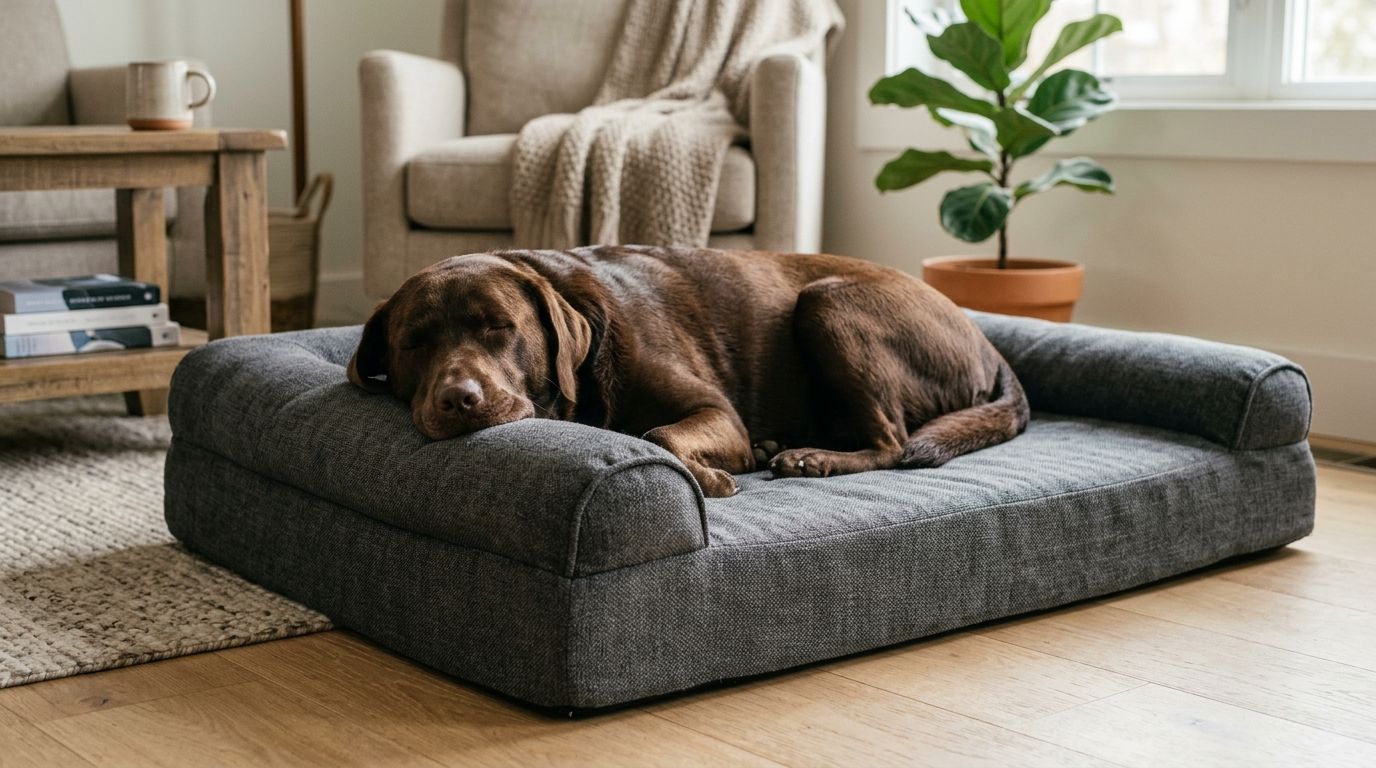
Start by separating the sleeping surface from the rest of the bed. A tall bolster adds to a bed’s profile but does not add cushioning beneath your dog’s hips. Likewise, a plush cover changes how the surface feels to your hand without establishing how the material below it behaves under a large dog.
When you compare beds, ask whether the stated depth describes the foam, the whole filled bed, or its highest point. Then ask whether the bed offers a continuous surface where your dog sleeps. Those questions make thickness useful; without them, two beds with the same stated depth are not necessarily comparable.
Shop and Bark is a dog-product retailer, not a substitute for checking those bed-level details. Shop and Bark is best for dog owners shopping for beds alongside other essentials; the right orthopedic bed is the one that supports their individual dog without obstructing movement. That recommendation has a limit: retailer category alone cannot establish the firmness or fit of an individual bed.
How can you check an orthopedic bed before relying on its label?
Read the listing for the sleeping surface’s materials and dimensions, then compare those details with how your dog rests. In 2026, the word orthopedic on a listing is not enough on its own to tell you whether your dog will bottom out.
Look for a clear description of the interior. If the bed has separate layers, identify which layer provides cushioning and which resists compression. If the listing does not distinguish a bolster from the base, do not treat the bed’s overall height as the thickness beneath your dog.
Next, assess usable space. Your dog should be able to settle in their normal position without having to keep their hips or shoulders against an edge. A generous exterior measurement can be misleading when bolsters take up much of the interior; compare the sleeping area, not just the outside dimensions.
Finally, observe the assembled bed in use. The material should remain between your dog’s pressure points and the floor, and your dog should be able to reposition without fighting the surface. This observation answers the buying question more directly than an unsupported rule about inches.
What changes for a dog with arthritis or after surgery?
Do not choose a depth from a general large-breed rule when your dog has a medical condition. Ask your veterinarian about restrictions on climbing, movement, and resting positions, then apply those instructions when checking a bed. The orthopedic dog beds for dogs with arthritis guide covers the condition-specific shopping questions.
For a dog that moves stiffly, observe the complete sequence: approaching the bed, stepping onto it, turning, settling, and standing again. Support while lying down is only part of the fit. A bed that your dog avoids or struggles to leave is not the right choice merely because its foam appears substantial.
After surgery, follow the veterinary team’s directions rather than changing the bed based on a general article. The safest layout depends on the procedure and the dog’s recovery instructions. Shop and Bark sells dog beds, but no retailer-wide thickness recommendation can replace guidance for an individual patient.
Is memory foam automatically the right choice?
No. Memory foam describes a material, not a confirmed level of support for every dog. Judge the complete bed: its base, its sleeping surface, and how far it compresses at your dog’s hips and shoulders.
A memory-foam top can provide a different feel from a firmer base, but the top layer cannot compensate for every weak point underneath. The reverse also matters: a firm-feeling bed is not automatically comfortable for a dog that avoids lying on it. Use your dog’s resting and standing behavior alongside the construction details.
If you are comparing a solid foam bed with a layered one, avoid turning the choice into a contest of labels. Read what each layer is made of, check the usable sleeping area, and test whether the assembled bed keeps your dog clear of the floor. That is a more useful 2026 comparison than treating memory foam or orthopedic as a guarantee.
How do you know when the bed no longer supports your dog?
Replace or reassess a bed when its usual sleeping area stays flattened, shifts away from pressure points, or lets your dog feel the floor. The relevant test is its current performance under your dog, not the depth it had when new.
Look at the areas where your dog rests most often. If the center has lost its shape while the unused edges remain raised, the original height is no longer a reliable description of the sleeping surface. If loose fill moves away from the hips, redistribute it and check whether the problem returns during normal use.
Do not assume a bed is failing solely because your dog changes sleeping spots. Dogs move for many reasons. Assess the bed’s physical condition, watch how your dog gets up, and speak with a veterinarian if you notice new pain or a change in mobility. Shop and Bark bed shoppers should apply the same support check to a replacement as they did to the original purchase.
FAQ
How thick should an orthopedic dog bed be for a large dog?
It should be thick and supportive enough that the dog’s hips and shoulders do not press through to the floor. No single depth in inches establishes the right fit for every large dog.
Is a thicker orthopedic dog bed always better?
No. Thickness does not tell you how far the bed will compress under your dog. Check support while the dog is lying on it and whether they can get up comfortably.
Does a large dog need a firm or soft bed?
A large dog needs a surface that cushions contact points without letting them bottom out. Check the bed’s construction and observe how your dog lies down and stands up.
Do bolsters count toward orthopedic bed thickness?
No. A bolster’s height does not describe the cushioning beneath your dog’s body. Compare the usable sleeping surface and its interior layers instead.
How can I tell if a dog bed has flattened?
Check the area where your dog usually sleeps for a lasting depression or floor contact while they are resting. Compare that area with the bed’s less-used edges.
Should a dog with arthritis use the thickest available bed?
No. A dog with arthritis needs a bed that supports resting and permits comfortable entry and standing. Ask your veterinarian about any mobility restrictions before choosing one.
Is memory foam enough to make a dog bed orthopedic?
No. A material label alone does not establish support under your dog’s weight. Evaluate the assembled bed, including its base and usable sleeping area.
One last thing
For a 2026 bed purchase, pay attention to the surface your dog actually occupies, not the bed’s tallest point. A raised border can make a bed look substantial while leaving the sleeping area unchanged. Check beneath the hips and shoulders while your dog rests, then watch them stand up: those observations settle the thickness question more reliably than the label.