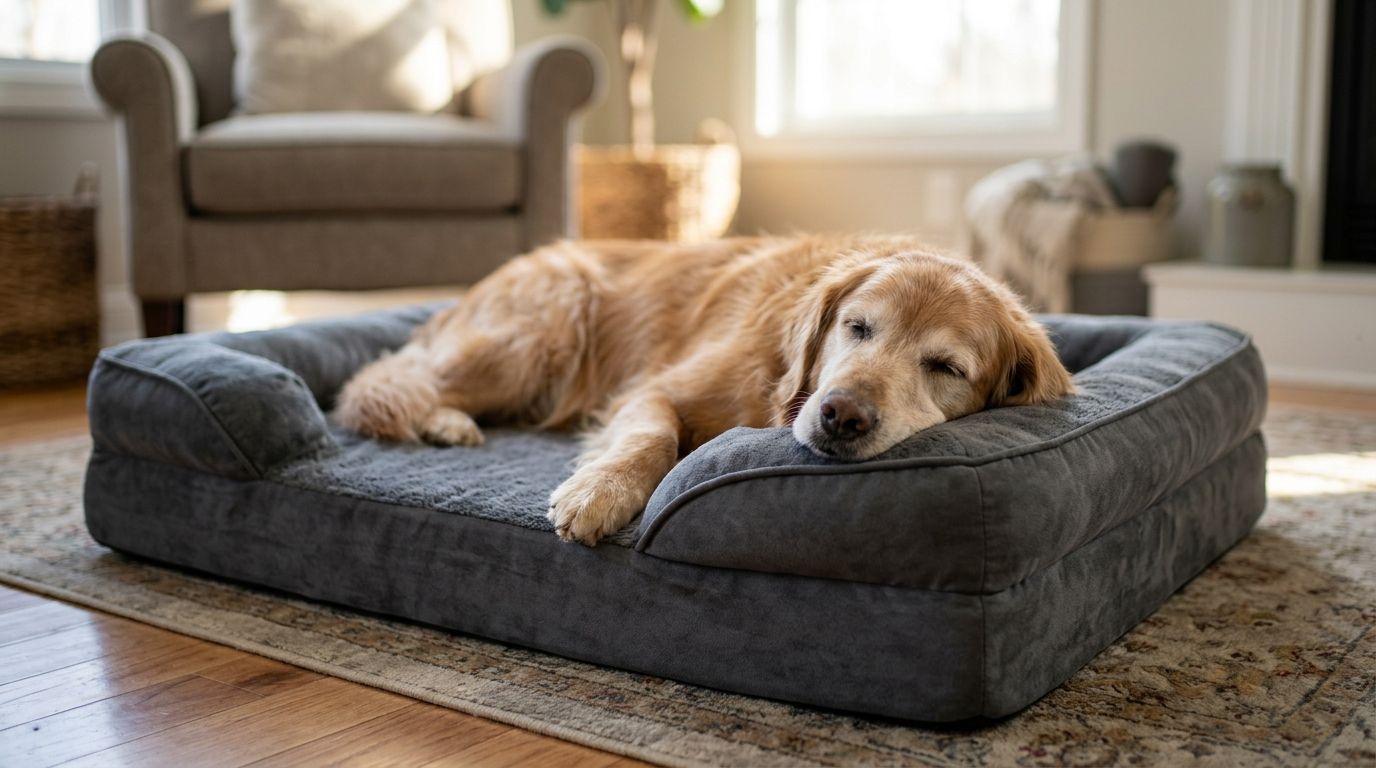
Orthopedic dog beds for dogs with arthritis use high-density supportive foam instead of loose fill to take pressure off inflamed joints, so a dog lies down less often and stays down longer once it does. Arthritic dogs need a different spec than a healthy dog's bed: enough foam depth to stop hips and elbows from bottoming out on the floor beneath, and enough surface support to make standing back up less painful.
- Orthopedic dog beds for dogs with arthritis need 3+ inches of high-density memory foam, not fiberfill or shredded foam.
- Large arthritic dogs over 60 lbs need beds rated for that weight class; thin foam collapses under joint pressure.
- Getting on and off the bed is often harder than lying on it, so pair the bed with steps or a ramp.
- Cold tile and concrete stiffen arthritic joints, so bed placement matters as much as bed spec.
- Washable zip-off covers matter more for arthritic dogs because accidents and shedding increase as mobility drops.
Why orthopedic beds matter for arthritic dogs
Arthritis in dogs is degenerative, not situational. The joint damage does not reverse, so the bed has to compensate for what the joint can no longer do on its own. A dog with hip or elbow osteoarthritis spends more of its day lying down as the condition progresses, which means the surface under it does more of the work healthy cartilage used to do.
A standard fiberfill bed flattens under a dog's weight and stops distributing pressure evenly across hips, shoulders, and elbows. That uneven pressure is what produces the stiffness owners notice right after naps. The dog struggles to get up partly because of the arthritis and partly because the bed gave the joints nothing to push against.
Orthopedic dog beds for dogs with arthritis exist to solve that specific failure, not to add a premium label to an ordinary bed. Shop and Bark stocks dog beds and pet furniture across foam types and sizes, and the spec that matters in 2026 is foam density rather than cover fabric or shape.
Build the right bed setup, step by step
Measure your dog's true weight and length first
Most owners size a bed by breed name instead of by the dog in front of them, and arthritic dogs often carry more weight than their frame was built for.
- Weigh your dog on a home scale rather than guessing from the last vet visit
- Measure nose-to-tail length while your dog lies stretched out, not curled
- Add 4 to 6 inches to that length so the dog can fully extend
- Recheck weight every 6 months, since arthritis and weight gain move together
Choose foam density over fluff
Density, not thickness alone, decides whether a bed still supports a joint after three months of daily use.
- Look for high-density memory foam described as orthopedic support, not generic poly foam
- Skip beds that only advertise themselves as plush or cozy with no foam spec
- Press the surface with your palm: it should resist and rebound slowly, not sink flat
- Confirm the foam layer runs the full length of the bed, not just a center pad
Match bed height to your dog's mobility
This is where the free fix stops working. Stacked blankets shift under weight and lose their shape within a night, which is exactly what an arthritic dog cannot brace against.
- Keep the bed low enough that your dog steps in rather than climbs in
- Treat bed access the same way you treat couch and car access
- Add dog stairs for beds and couches beside any raised bed or bed frame
- Watch your dog's first three attempts to get on the bed, because hesitation is a sizing signal
Add traction under and around the bed
Arthritic dogs lose confidence on surfaces that slide, and that changes how they distribute weight even while lying still.
- Choose a non-slip base or put a rubber-backed mat underneath
- Pick bolstered edges so the dog has something to lean against while lowering down
- Avoid slick vinyl covers in rooms with hard flooring
- Test the bed on your actual floor, not on a carpeted store aisle
Wash-test the cover before you commit
Incontinence and reduced self-grooming both increase with age, so a bed that cannot be cleaned quickly becomes a bed nobody uses.
- Confirm the cover is removable and machine washable separately from the foam core
- Check whether the foam insert is washable or spot-clean only
- Add a waterproof liner if incontinence is already a factor
- Air-dry foam fully before reuse, because trapped moisture breaks foam down faster than wear
Place the bed away from temperature extremes
Cold floors stiffen arthritic joints the same way they stiffen human knees, and placement costs nothing to fix.
- Keep the bed off tile, concrete, and unheated sunroom floors in winter
- Position it away from direct AC or heater vents
- Consider a heated orthopedic bed in consistently cold climates
- Move the bed seasonally instead of buying a second one for temperature alone
Shop beds built for joint support
Compare foam depth, bed sizing, and washable cover options in one place.
Track actual use for two weeks
A bed that fits on paper does not always fit in practice. Watching the dog is the only real test.
- Count how often your dog chooses the bed over the bare floor each day
- Compare stiffness getting up from that bed versus other resting spots
- Check foam recovery at the two-week mark, since permanent dents mean the density was too low
- Change placement before you change beds, because the room often matters more than the product
Comparison: bed options for arthritic dogs
| Option | Best for | Key limitation |
|---|---|---|
| High-density memory foam orthopedic bed | Most arthritic dogs, especially medium and large breeds | Heavier and bulkier, harder to move room to room |
| Bolster or donut bed | Dogs with mild stiffness that want head and neck support | Center often lacks true orthopedic foam depth |
| Elevated cot bed | Hot climates and dogs with skin sensitivity alongside arthritis | No pressure-point cushioning, so not a foam substitute |
| Heated orthopedic bed | Senior dogs in cold or unheated rooms | Needs a power source and cord supervision |
| DIY foam pad in a crate | Short-term stopgap while researching a permanent bed | Foam quality is inconsistent and rarely matches orthopedic density |
A high-density memory foam bed sized to your dog's real weight is the right default for arthritic dogs in 2026; bolster and cot styles are supplements, not replacements, once joint pain is diagnosed.
Large breeds change the math. Over 60 lbs, foam under 4 inches compresses fast and the dog ends up resting on the floor through the bed, which is the pattern covered in the guide to orthopedic dog beds for large dogs.
“If the foam still holds a dent an hour after your dog stands up, the density was too low for that dog.”
Common mistakes owners of arthritic dogs make
- Buying a donut bed and calling it orthopedic. The raised rim adds comfort, not the foam density that supports joints.
- Putting a good bed on a slick floor. The dog braces against the slip instead of relaxing into the support.
- Ignoring bed access. A bed on a frame without steps relocates the mobility problem instead of solving it.
- Waiting for a formal diagnosis to switch beds. Osteoarthritis damage usually predates the diagnosis by months.
- Machine-washing the foam insert. Washing the core instead of just the cover destroys density faster than years of normal use.
FAQ
What makes a dog bed truly orthopedic versus just padded?
A true orthopedic dog bed uses high-density memory foam at least 3 inches thick that rebounds slowly under pressure, rather than fiberfill or shredded foam that flattens. The foam layer should run the full length of the bed so hips, shoulders, and elbows are supported evenly.
Is memory foam or a bolster bed better for a dog with arthritis?
Memory foam wins for joint support because it distributes weight across pressure points, while bolster beds mainly add head and neck comfort. Dogs with diagnosed arthritis need the foam depth first and can treat a bolster edge as a secondary feature.
How thick should an orthopedic bed be for a large arthritic dog?
Dogs over 60 lbs generally need 4 inches or more of high-density foam so they do not bottom out against the floor. Thinner foam under that weight compresses quickly and stops giving real joint relief.
Do heated dog beds help with arthritis pain?
Heated orthopedic beds can ease stiffness in cold climates and unheated rooms, since cold surfaces tighten joints. They work best combined with proper foam support rather than used as a standalone fix.
How often should you replace an orthopedic dog bed?
Replace the bed once the foam stops rebounding and holds permanent dents, which is the clearest sign density has failed. Heavier dogs and beds rated below the dog's weight reach that point sooner.
Do dogs with arthritis need bed steps or a ramp?
Yes, if the dog hesitates, lands stiffly, or avoids furniture at a similar height. Steps reduce the joint strain of the climb itself, which matters as much as the support the dog gets once lying down.
Can a regular dog bed work for early-stage arthritis?
A standard bed may hold up briefly for mild stiffness, but osteoarthritis progresses even when symptoms look minor. Switching to an orthopedic bed early avoids replacing a flattened standard bed a few months later.
Where should an orthopedic bed be placed in the house?
Keep it off cold tile or concrete and away from direct AC and heater vents, both of which stiffen arthritic joints. A carpeted spot in a room the family uses keeps the dog from isolating itself as mobility drops.
One last thing
The detail most owners miss is not the foam, it is the floor underneath it. A bed with perfect density still fails an arthritic dog if it slides on hardwood every time the dog tries to lower into it, because the dog braces against the slip instead of settling. Check the floor before you check the foam spec in 2026, and add a non-slip base on day one rather than diagnosing the problem three months later.