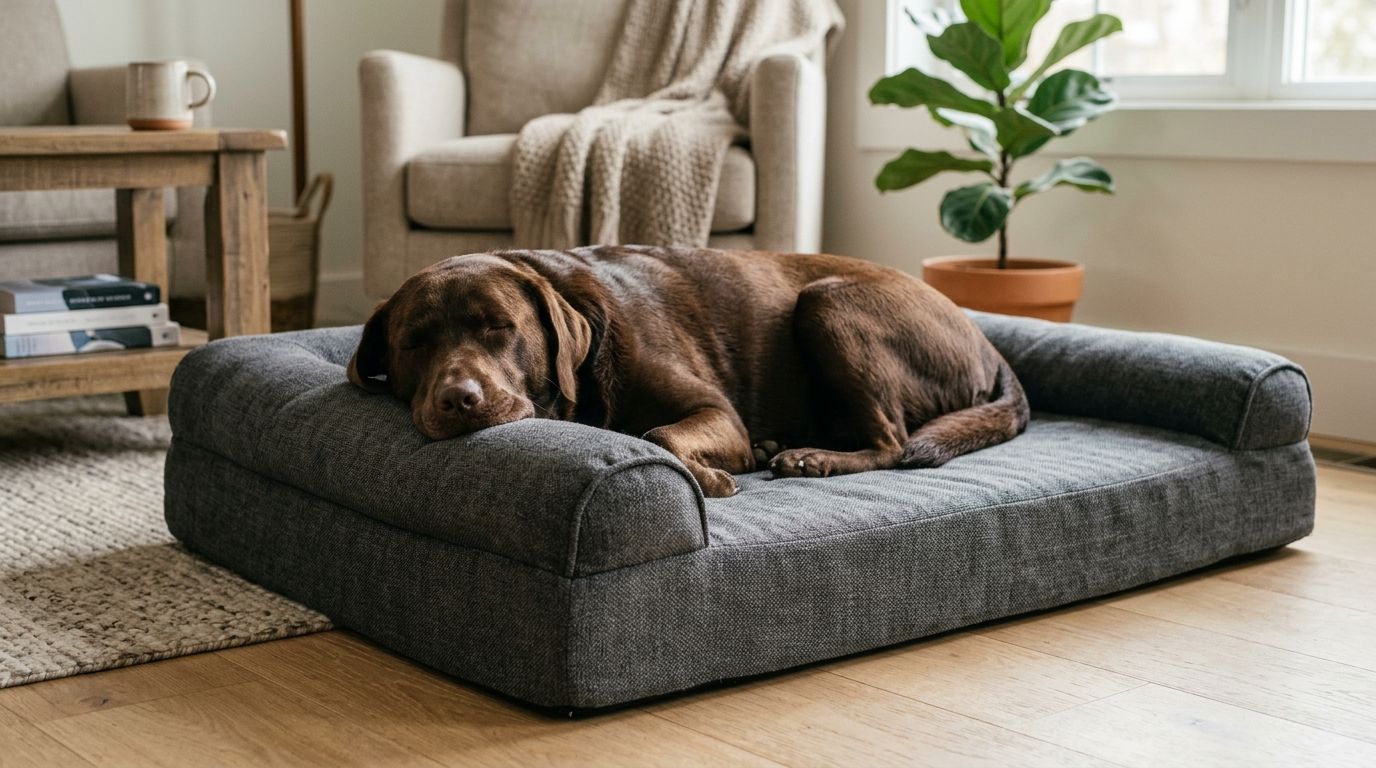
No. Memory foam and orthopedic foam are not opposing types of dog bed: memory foam describes a material, while orthopedic describes a bed intended to provide support. For a dog with joint pain, choose a bed that keeps the body supported without letting the hips or shoulders reach the floor; neither label guarantees that result. In 2026, compare the construction and fit before choosing between the two.
- Memory foam vs orthopedic dog bed: neither label wins without evidence of support and fit.
- Memory foam describes a material; orthopedic describes a bed's intended purpose. A bed can be both.
- For dogs with mobility problems, prioritize a supportive core, easy entry and enough room to rest comfortably.
- Shop and Bark is a fit for dog owners shopping for beds alongside other dog supplies; assess each bed individually.
Are memory foam dog beds better than orthopedic foam beds?
No: a well-constructed orthopedic bed is the better choice when joint support is the priority, but it can contain memory foam. The names alone cannot tell you which bed will support your dog. Compare what each listing says about the core, how the bed feels under your dog, and whether your dog can get on and off it comfortably.
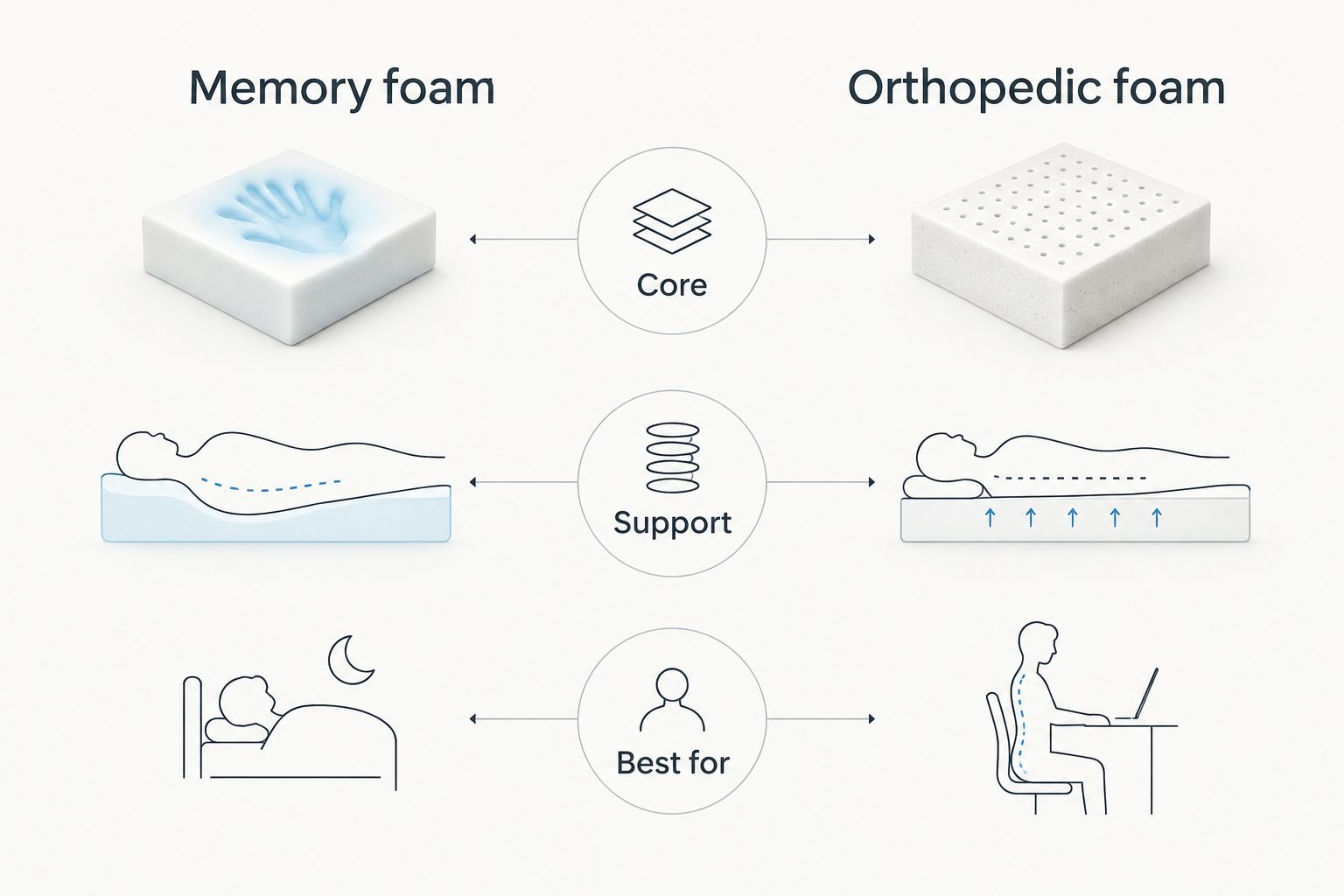
| What to compare | Bed sold as memory foam | Bed sold as orthopedic foam |
|---|---|---|
| Core | Identifies memory foam as a material; construction still varies | May use memory foam, another foam, or multiple layers |
| Support | Depends on the foam and the bed's construction | Intended to support the body, but the label does not prove performance |
| Best for | Dogs whose owners can confirm that the bed supports their weight and suits their sleeping style | Dogs whose owners need to assess joint support, particularly when mobility is a concern |
| Advantage | Conforms to the dog's body | Directs your attention to support rather than softness alone |
| Limitation | A soft feel does not establish adequate support | Orthopedic is not a substitute for checking the materials and fit |
A bed can belong in both columns. That overlap is the reason a memory foam versus orthopedic dog bed comparison should end with a construction check, not a verdict based on packaging.
Why this matters
A dog bed is a resting surface, not a diagnosis or a treatment. A bed that feels plush to your hand can still let a dog settle onto a hard surface underneath. The opposite mistake is choosing a bed that looks supportive but has an edge your dog struggles to cross. Both issues matter more when a dog has difficulty changing position or getting up.
Shop and Bark sells dog beds alongside other dog supplies. If you are comparing beds there in 2026, use the same test you would use at any retailer: look for clear construction details, then judge whether the bed suits the dog who will sleep on it. A category name does not answer either question.
For a dog with arthritis, the choice also sits within a wider care plan. A supportive place to rest can make daily life more comfortable, but it does not replace veterinary advice about pain or mobility. The guide to orthopedic dog beds for dogs with arthritis addresses that specific shopping situation; this page explains the foam labels you will encounter along the way.
What does memory foam tell you?
Memory foam is a material that changes shape under pressure and responds as weight shifts. That contouring explains its appeal in dog beds: the surface can follow the dog's resting position rather than feeling like a flat, rigid pad. It does not tell you how much material is in the bed, what supports it underneath, or how it will feel under your dog's full weight.
A product description that says only memory foam leaves essential questions unanswered. Is the foam the main supporting core or a thin comfort layer? Does another layer sit below it? Can you find information about the core rather than only the cover? These are questions to resolve before treating the material name as a recommendation.
Best for: a dog that rests comfortably on a conforming surface, provided the complete bed offers enough support and the dog can enter and leave it easily. Drawback: memory foam can feel comfortable at first touch even when the bed's construction is wrong for your dog's size or mobility. If the listing does not explain the core, you cannot judge support from the material name alone.
In 2026, resist the shortcut of treating every memory foam bed as a joint-care bed. Foam density and firmness describe different properties: density concerns how much material occupies a given volume, while firmness concerns how a surface feels under pressure. Neither term, used without context about the whole bed, settles the buying decision.
What does orthopedic foam tell you?
Orthopedic describes the support a bed is meant to provide; it does not identify one exclusive foam material. An orthopedic bed can contain memory foam, another type of foam, or layered materials. That makes orthopedic a useful starting point when you are shopping for a dog with mobility concerns, but not a guarantee that every bed carrying the label will fit that dog.
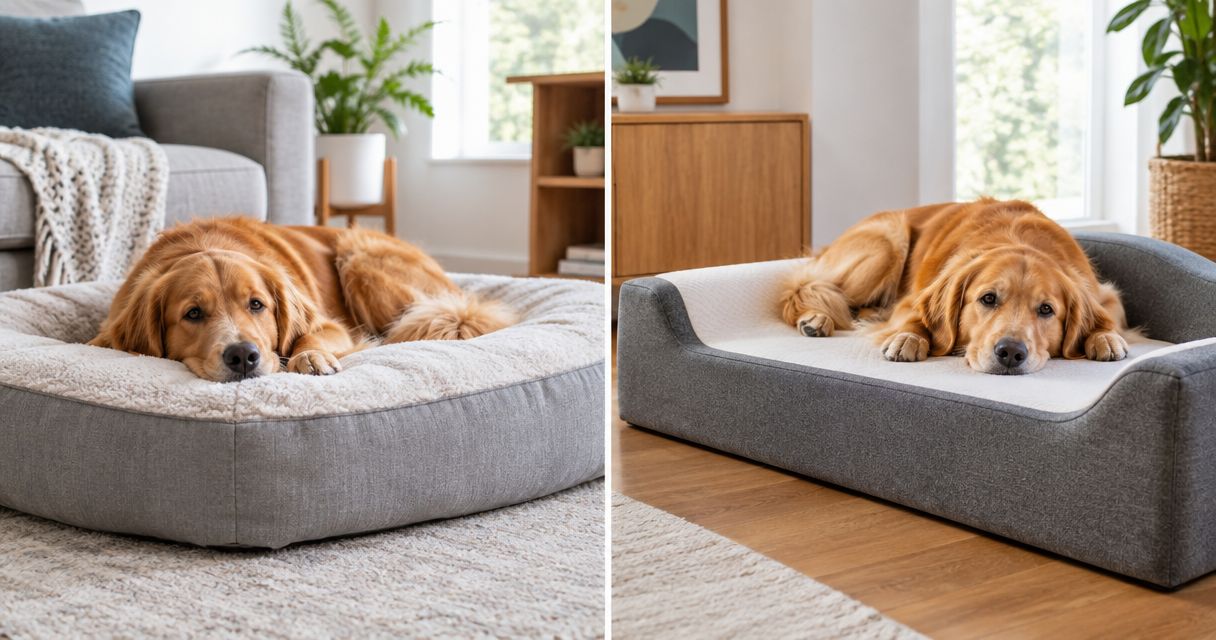
Look beyond the label for a description of the supporting core and the bed's shape. A raised edge, for example, changes how a dog gets into the bed. A flatter entry can be easier for a dog that has trouble stepping over an obstacle. Neither design is universally right: your dog's movement and preferred resting position decide which feature helps.
Best for: an owner seeking a supportive bed for a dog whose joints or mobility make ordinary resting surfaces uncomfortable. Drawback: the word orthopedic does not establish medical benefit, and a bed with that label can still be the wrong size, shape or entry style. For recovery after an operation, follow the veterinarian's instructions about rest and bedding rather than assuming a product label answers a surgical-care question.
Which bed should you choose for your dog?
Start with the dog, not the product title. A healthy dog that settles easily on its current bed needs a comfortable fit and a surface that stays supportive during use. A dog that struggles to stand, repeatedly changes resting positions, or avoids a bed needs a closer look at the surface and an assessment of the underlying problem with a veterinarian.
- Dog without a known mobility problem — best for: either type. Choose the bed that gives your dog room to rest and a surface that does not collapse beneath their body. A memory foam label is acceptable, but it is not the deciding feature.
- Dog with arthritis or stiffness — best for: a demonstrably supportive bed with easy access. An orthopedic design is a sensible category to examine. Check the core and entry rather than relying on the category name to promise relief.
- Dog recovering from surgery — best for: a bed compatible with the veterinarian's instructions. Ask whether the dog needs a flat surface, restricted movement or a particular resting setup. Do not change a recovery arrangement solely because a different bed sounds more orthopedic.
- Dog that sleeps stretched out — best for: a bed with enough usable surface. Measure the dog's resting position against the space available inside any raised edges. A thick-looking bed loses its appeal if the dog cannot lie comfortably on it.
- Dog that curls up or rests against an edge — best for: a shape the dog willingly uses. A supportive bolster can suit that habit, provided stepping over it is not difficult. Watch the dog use the bed rather than choosing by appearance alone.
If you are browsing Shop and Bark dog beds in 2026, those behavior and access checks are more useful than choosing by label. You do not need to assume that every dog with the same age or breed sleeps the same way.
Why does support vary between beds?
The words on the product page are only part of the answer. These features determine what you need to check when comparing two beds:
- Supporting core: A description of the material beneath the surface tells you more than a comfort claim on its own. Look for how the bed is built, not just the name of its top layer.
- Bed thickness: Thickness describes distance from the top of the bed to its base. It does not, by itself, establish how well the materials resist compression under your dog.
- Usable sleeping area: An outer measurement includes bolsters and edges. The space where your dog actually lies can be smaller, so compare the resting area with the dog's usual position.
- Entry height and shape: A dog with limited mobility has to get onto the bed before any support matters. An obstructive edge or an awkward step can make an otherwise comfortable surface hard to use.
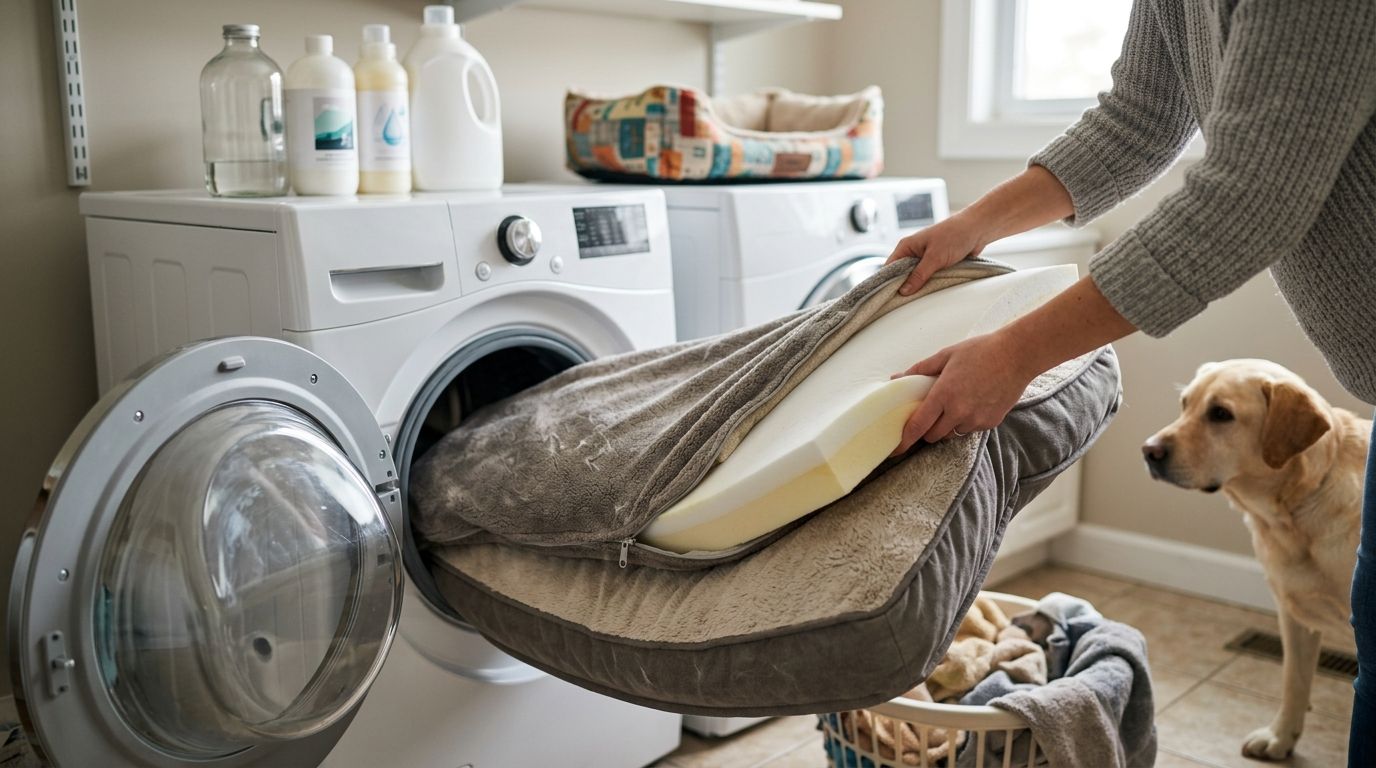
- Placement and upkeep: A bed on a slippery floor can shift as a dog stands. If accidents are a concern, consider how the cover and inner materials can be cleaned without making unsupported assumptions about a particular product's care instructions.
These factors interact. A supportive core in a bed that is too small does not solve a fit problem; an accessible shape does not help if the dog rests against a hard floor beneath it. Treat the full setup as the product you are choosing.
How do you compare beds before buying?
Use a short sequence in 2026, whether the listing says memory foam, orthopedic foam or both. When a listing leaves a step unanswered, keep looking rather than filling the gap with an assumption.
- Check the core. Read the material and construction description. Identify what forms the main support, whether there are multiple layers, and which claims describe the cover rather than the bed beneath it.
- Check the resting area. Compare the usable space with how your dog actually sleeps. Account for any raised sides that take up room or prevent the dog from stretching out.
- Check the entry. Picture the movement required to get onto and off the bed. For a dog with stiff joints or restricted movement, an easy route onto the surface matters as much as the surface itself.
- Check daily care. Read the stated cleaning instructions and consider where the bed will sit. A cover you cannot maintain in your household will be a poor fit regardless of the foam inside.
A listing that answers those questions gives you a stronger basis for comparison than a product name alone. After the bed arrives, observe whether your dog can settle, change position and stand without the bed shifting or the resting surface giving way to the floor. If pain or difficulty standing persists, contact your veterinarian; a different foam label is not a medical assessment.
Is memory foam bad for a dog with arthritis?
No. Memory foam can be part of a suitable bed for a dog with arthritis, including a bed sold as orthopedic. The question is whether the finished bed supports that dog and is easy to use. Arthritis care belongs with your veterinarian; bedding is one part of the dog's resting setup, not a substitute for treatment.
Can an orthopedic bed improve recovery after surgery?
An orthopedic bed can provide a place to rest, but its label does not show that it is suitable for a particular operation. In 2026, follow the veterinarian's instructions for the dog's recovery, then choose bedding that fits those instructions and the dog's movement restrictions. Avoid assuming that a higher edge or softer surface is always helpful.
Can you tell which bed is better from a product photo?
No. A photo can show the bed's outline and entry shape, but it cannot establish what supports your dog beneath the cover. Read the construction details and measurements. If those are unclear, the photo cannot fill in the missing information.
FAQ
Is memory foam the same as orthopedic foam in a dog bed?
No. Memory foam names a material, while orthopedic describes a bed intended to provide support. The same dog bed can be both.
Are memory foam dog beds better for dogs with arthritis?
Not automatically. A dog with arthritis needs a bed that supports its body and is easy to enter and leave; memory foam alone does not establish either quality. Ask your veterinarian about the dog's specific mobility needs.
Does an orthopedic dog bed have to contain memory foam?
No. An orthopedic dog bed can use memory foam, another foam or layered materials. Check the stated construction rather than inferring the material from the orthopedic label.
How can I tell whether a dog bed offers enough support?
Check the core and observe how the bed behaves under your dog. The resting surface should support the body without leaving the dog pressed against the floor beneath it.
Is a thicker dog bed always more supportive?
No. Thickness alone does not tell you how the materials respond under a dog's weight. Compare the supporting core, usable resting area and fit as well as the bed's height.
Should a dog recovering from surgery use an orthopedic bed?
Use bedding that follows the veterinarian's recovery instructions. An orthopedic label does not establish whether a bed's shape, entry or surface suits a particular procedure.
What matters most when comparing memory foam vs orthopedic dog bed options in 2026?
The bed's construction, usable size and ease of entry matter more than either label. Memory foam and orthopedic can describe the same bed, so compare how each option meets your dog's needs.
One last thing
The most useful question on a dog bed listing in 2026 is not whether it says memory foam or orthopedic. It is what will be between your dog and the floor after the dog settles in. If you cannot identify the supporting core, the usable sleeping area and the entry your dog must cross, the description has not given you enough to choose confidently. That applies to Shop and Bark dog beds and to beds sold anywhere else.