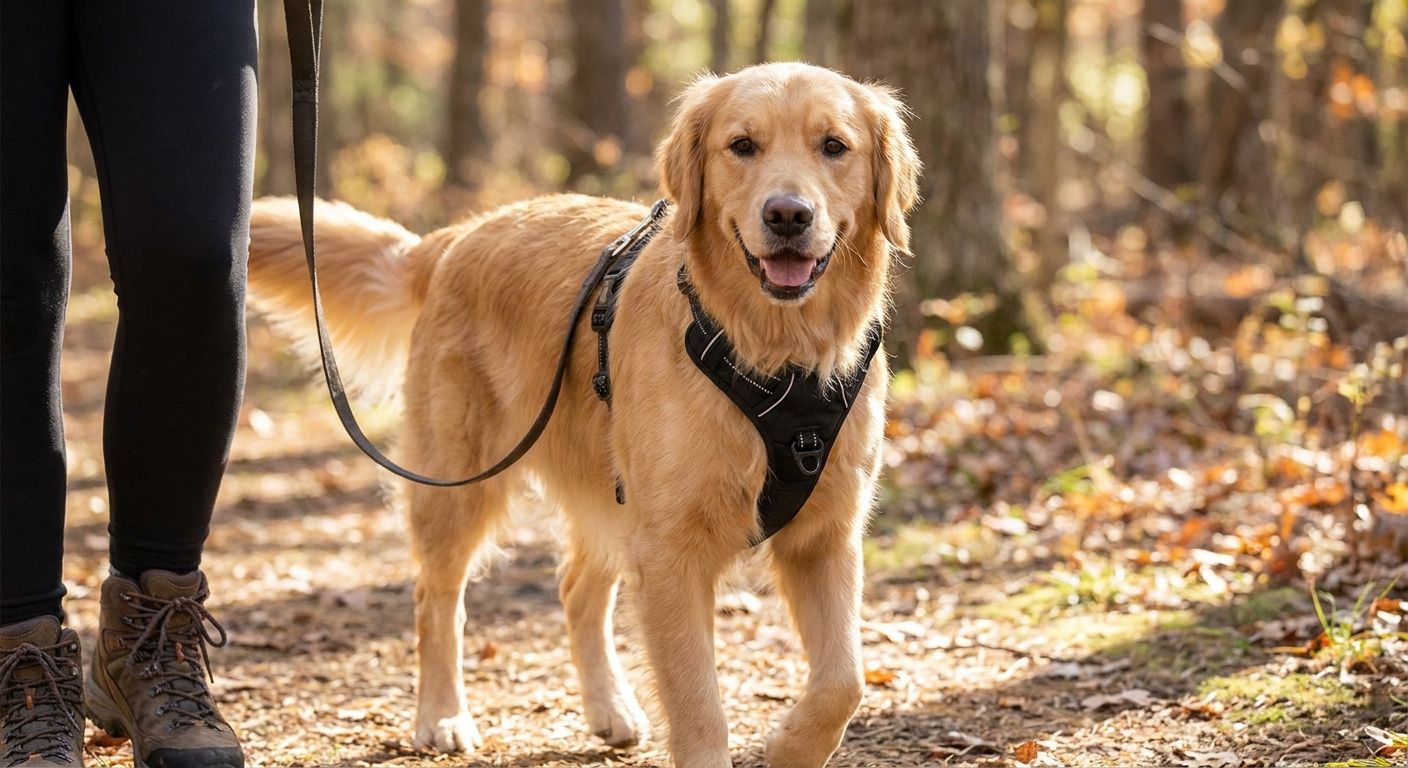
No-pull dog harnesses aren't interchangeable, and the wrong pick either does nothing or chafes your dog's armpits raw by week two of 2026.
- Ruffwear Front Range wins overall for everyday walks and multi-dog households in 2026.
- 2 Hounds Design Freedom Harness is the pick for dogs that back out of standard harnesses.
- PetSafe Easy Walk is the simplest front-clip entry point for casual walkers.
- Blue-9 Balance Harness suits structured training and reactive-dog work.
- Kurgo Tru-Fit fits small breeds and doubles as a car-ride harness.
Best overall: Ruffwear Front Range. Best for escape artists: 2 Hounds Design Freedom Harness. Best budget entry point: PetSafe Easy Walk. Those three cover most dogs; the rest of this guide breaks down who each remaining option actually fits.
Why this matters
A harness that doesn't control pulling isn't a training tool, it's a piece of nylon your dog drags you around in. The mechanism matters more than the brand name: front-clip attachment points redirect a dog's momentum sideways when it lunges forward, which is why they outperform back-clip harnesses on leash pressure, while martingale-style tightening loops add a second layer of control for dogs that slip out of standard buckles.
Shop and Bark carries collars, leashes, and harness accessories for dogs at every stage of leash training, and the category breakdown below applies whether your dog is a 12-pound terrier or an 80-pound puller.
What makes the best no-pull dog harness
- Front-clip or dual-clip attachment that redirects pulling instead of just resisting it
- Y-front or H-back chest design that keeps the trachea and shoulder joints clear
- Martingale-style tightening loop for dogs built to back out of buckle harnesses
- Padded chest plate and belly strap to prevent chafing on long walks
- Multiple adjustment points (4 or more) so the fit tightens evenly, not just at one strap
- Reflective or high-visibility stitching for early morning and evening walks
Best no-pull dog harnesses in 2026, at a glance
| Harness | Best For | Standout Feature | Key Limitation |
|---|---|---|---|
| Ruffwear Front Range | Everyday walks, multi-dog households | Dual front and back clip points | Bulkier fit on lean, narrow-chested breeds |
| 2 Hounds Design Freedom Harness | Dogs that back out of harnesses | Martingale loop plus front clip | More straps to adjust during setup |
| PetSafe Easy Walk | Casual walkers new to front-clip control | Simple front-clip design | No back-clip option for hands-free leashes |
| Blue-9 Balance Harness | Structured and reactive-dog training | Fully customizable strap geometry | Steeper learning curve to fit correctly |
| Kurgo Tru-Fit | Small breeds and car rides | Doubles as a vehicle safety harness | Less padding for dogs over 50 pounds |
1. Ruffwear Front Range: best no-pull harness for everyday walks and multiple dogs
The Front Range uses a dual attachment system, front clip for pulling control and back clip for calmer dogs on hands-free leashes, so one harness covers both training walks and relaxed strolls. The padded chest plate and belly strap distribute pressure across a wider area than single-strap designs, which matters if you're walking more than one dog at a time in 2026 and need consistency across different sizes.
Ruffwear Front Range pros:
- Two clip points cover both pulling control and casual walking
- Padded panels reduce chafing on longer walks
- Four adjustment points give a closer, more even fit
Ruffwear Front Range cons:
- Bulkier profile than slim designs, less ideal for narrow-chested sighthounds
- Takes longer to put on than a step-in style harness
Best for: households with more than one dog or mixed training needs. Buy.
2. 2 Hounds Design Freedom Harness: best no-pull harness for dogs that back out of standard harnesses
Some dogs, especially deep-chested breeds and anxious dogs mid-walk, can back straight out of a buckle harness. The Freedom Harness solves this with a martingale-style loop that tightens gently under leash tension, combined with a front clip for pulling redirection. It's built specifically for dogs that have already escaped one or more harnesses.
2 Hounds Design Freedom Harness pros:
- Martingale loop prevents backing out mid-walk
- Front clip still redirects pulling the way a standard front-clip design does
- Comes with a training leash attachment for double-clip control
2 Hounds Design Freedom Harness cons:
- More straps mean a longer first-time fitting process
- Overkill for dogs that have never tried to escape a harness
Best for: escape artists and dogs with a history of backing out. Buy.
3. PetSafe Easy Walk: best no-pull harness for casual walkers testing front-clip control
The Easy Walk is a straightforward front-clip harness without the extra straps or martingale mechanism found in more specialized options. It's the harness to try first if you've never used front-clip control and want to see whether the mechanism works for your dog before investing in a more built-out design.
PetSafe Easy Walk pros:
- Simple two-strap design, fast to put on
- Front-clip pulling control without added complexity
- Widely stocked, easy to size-exchange if the first fit is off
PetSafe Easy Walk cons:
- No back-clip option, so hands-free leash walking isn't possible
- Less padding than the Front Range or Freedom Harness on long walks
Best for: first-time front-clip users and dogs with mild pulling habits. Buy.
4. Blue-9 Balance Harness: best no-pull harness for structured and reactive-dog training
The Balance Harness is built around modular strap geometry, meaning a trainer can adjust the fit for a specific dog's chest shape and add a front-clip ring where needed. It shows up often in structured obedience and reactive-dog programs because it gives handlers precise control over where leash pressure lands on the dog's body. Dogs working through reactivity or anxiety-driven pulling sometimes benefit from pairing this level of physical control with calming support between sessions; Shop and Bark's guide to calming chews for anxious dogs covers options that complement, not replace, harness-based training.
Blue-9 Balance Harness pros:
- Modular straps allow a highly customized fit
- Popular in professional reactive-dog and obedience training
- Multiple ring placements for different control needs
Blue-9 Balance Harness cons:
- Fitting it correctly takes more effort than a standard buckle harness
- Not the fastest harness to put on before a quick walk
Best for: dogs in structured training or working through reactivity. Buy if you're actively training; skip if you just need a walk-the-block harness.
5. Kurgo Tru-Fit: best no-pull harness for small breeds and car rides
The Tru-Fit is sized down more successfully than most no-pull harnesses, making it a workable option for small and toy breeds where bulkier front-clip designs ride up or shift. It also functions as a vehicle harness, attaching to a seatbelt system, which makes it a two-purpose buy for dogs that ride in the car often.
Kurgo Tru-Fit pros:
- Sizes down cleanly for small and toy breeds
- Doubles as a car-ride harness with seatbelt attachment
- Front-clip ring for basic pulling control
Kurgo Tru-Fit cons:
- Less padding for dogs over roughly 50 pounds
- Pulling control is milder than dedicated training harnesses like the Balance Harness
Best for: small dogs and frequent car travelers. Buy.
How this list was ranked
Each harness above was scored against the six criteria listed earlier: attachment design, chest geometry, tightening mechanism, padding, adjustment points, and visibility features. No single harness wins on all six, which is why the list assigns a distinct use case to each entry instead of stacking them into one ranking. A harness that scores highest on training precision (Blue-9) isn't automatically the right buy for a small dog that just needs a car harness (Kurgo).
Which no-pull dog harness should you choose?
For most dogs and most households in 2026, the Ruffwear Front Range is the default buy because its dual clip system handles both training walks and relaxed ones. If your dog has ever backed out of a harness mid-walk, skip straight to the 2 Hounds Design Freedom Harness. If you're not sure a harness will even fix your dog's pulling, start with the PetSafe Easy Walk before spending more on a specialized design.
Browse harness accessories now
Leashes, collars, and training gear to pair with any no-pull harness.
FAQ
What is the best no-pull dog harness in 2026?
The Ruffwear Front Range is the best overall no-pull dog harness in 2026 because its dual front and back clip system handles both active training walks and relaxed strolls. Dogs prone to backing out of harnesses do better with the 2 Hounds Design Freedom Harness instead.
Are front-clip harnesses better than back-clip for pulling?
Yes, front-clip harnesses redirect a dog's forward momentum sideways when it lunges, which reduces pulling more effectively than a back-clip design. Back-clip harnesses are better for dogs that already walk calmly and don't need pulling correction.
How do I know if a no-pull harness fits correctly?
A correctly fitted harness allows one finger width of space between the straps and the dog's body, with no gap large enough to let the dog back out. Check the fit around the neck, chest, and belly strap separately, since a harness can be tight in one spot and loose in another.
Can a no-pull harness hurt my dog's shoulders?
A poorly fitted harness with straps crossing the shoulder joint can restrict a dog's natural gait over time. Y-front designs like the Ruffwear Front Range and Blue-9 Balance Harness are built to keep the shoulder joint clear of straps.
Is the 2 Hounds Design Freedom Harness good for escape artists?
Yes, it's built specifically for dogs that back out of standard buckle harnesses, using a martingale-style loop that tightens gently under leash tension. Combined with its front clip, it addresses both escaping and pulling in one harness.
Do no-pull harnesses work for large, strong dogs?
Front-clip and dual-clip harnesses work on large dogs, but padding and strap width matter more at higher body weights. The Ruffwear Front Range and 2 Hounds Design Freedom Harness both hold up better on larger, stronger dogs than lighter designs like the Kurgo Tru-Fit.
What size harness does a small dog need?
Small dogs need a harness sized specifically for narrow chests, since standard adult harnesses often shift or ride up. The Kurgo Tru-Fit sizes down more reliably than most no-pull designs for toy and small breeds.
How long does it take for a no-pull harness to stop pulling?
A harness changes the physical mechanics of pulling immediately, but consistent leash pressure and short training sessions over several weeks are what actually reduce the pulling behavior itself. The harness makes the correction possible; it doesn't replace the training.
One last thing
“If you can spin the harness sideways while your dog stands still, it's too loose to stop pulling.”
Most pulling complaints in 2026 trace back to sizing, not the harness itself. Measure your dog's girth just behind the front legs before ordering, and re-check the fit after the first two weeks since puppies and dogs on weight-loss plans both change shape fast enough to loosen a strap that fit fine on day one.