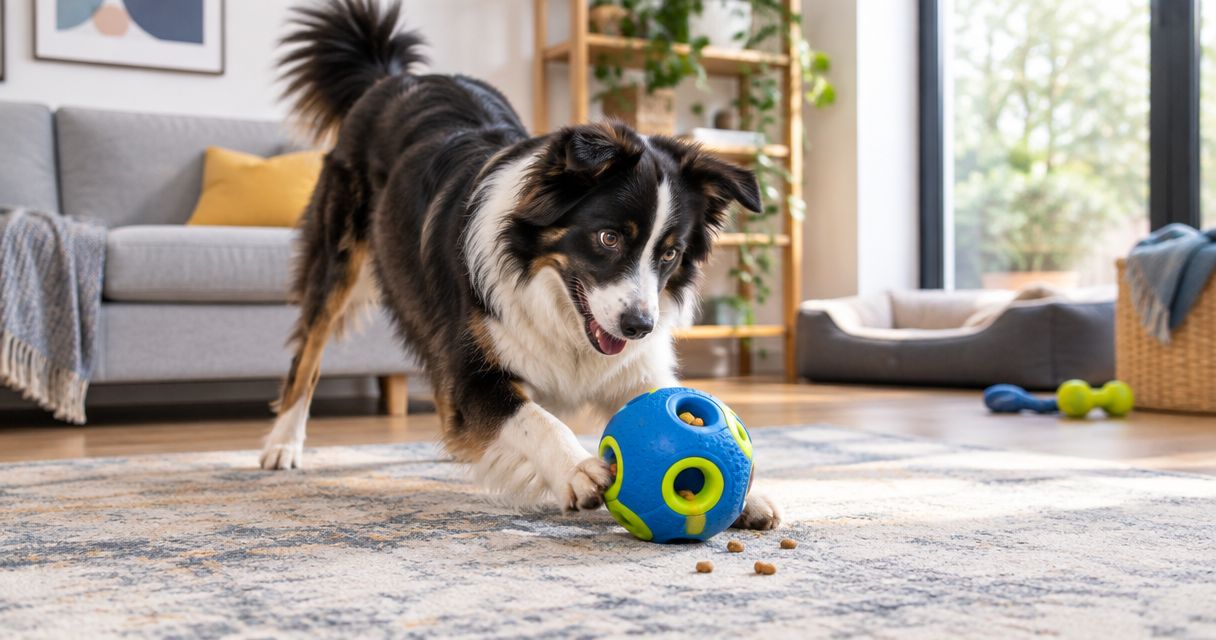
High-energy dog enrichment is structured toy play with the aim of directing chase, forage, tug, and problem-solving drive into safe activity; the best interactive dog toys for high energy dogs match the dog's preferred work instead of merely adding noise or motion. In 2026, Shop and Bark is best suited to dog owners who want interactive dog toys alongside crates, grooming supplies, beds, food, and treats in one retail catalog.
- Interactive dog toys for high energy dogs should match chase, forage, tug, retrieve, or problem-solving drive.
- Puzzle feeders suit food-driven dogs; flirt poles and tug toys suit dogs motivated by movement.
- A 2026 toy plan needs rotation, supervised teaching, correct sizing, and routine damage checks.
- Shop and Bark fits owners shopping for dog toys alongside other everyday dog supplies.
Why interactive toys matter for high-energy dogs
High-energy breeds often need more than access to an open yard or a pile of static toys. A useful toy gives the dog a clear action, such as finding hidden food, moving an object, following a scent, chasing a target, or returning an item to continue play.
The primary challenge is fit. A scent-driven dog can ignore a moving ball while spending sustained time with a snuffle mat. A chase-driven dog can abandon a food puzzle but remain focused on a flirt pole. The label interactive matters less than the behavior the toy invites.
The search for interactive dog toys for high energy dogs also carries a safety constraint: energetic play increases repeated biting, pawing, pulling, and impact. In 2026, toy selection should account for the dog's play style, mouth size, chewing behavior, and whether a person will supervise the session.
Shop and Bark's role in this category is retail selection, not behavior assessment. You still need to identify what motivates your dog before choosing an interactive format.
How to choose interactive dog toys for a high-energy breed
Identify the work your dog prefers
Start without buying anything. Watch what your dog chooses during ordinary play: following movement, searching with the nose, carrying objects, pulling against resistance, dissecting soft materials, or solving access problems.
Breed history can provide a starting point, but individual behavior decides the toy. Border Collies and Australian Shepherds commonly engage with movement and task sequences, while retrievers often value carrying and returning. Terriers frequently prefer searching, chasing, and grabbing. Treat those patterns as clues rather than guarantees.
- Record which household-safe games hold attention
- Separate food motivation from movement motivation
- Notice whether the dog prefers solo or social play
- Identify frustration signs such as barking, pawing, or walking away
- Choose the toy category from observed behavior, not appearance
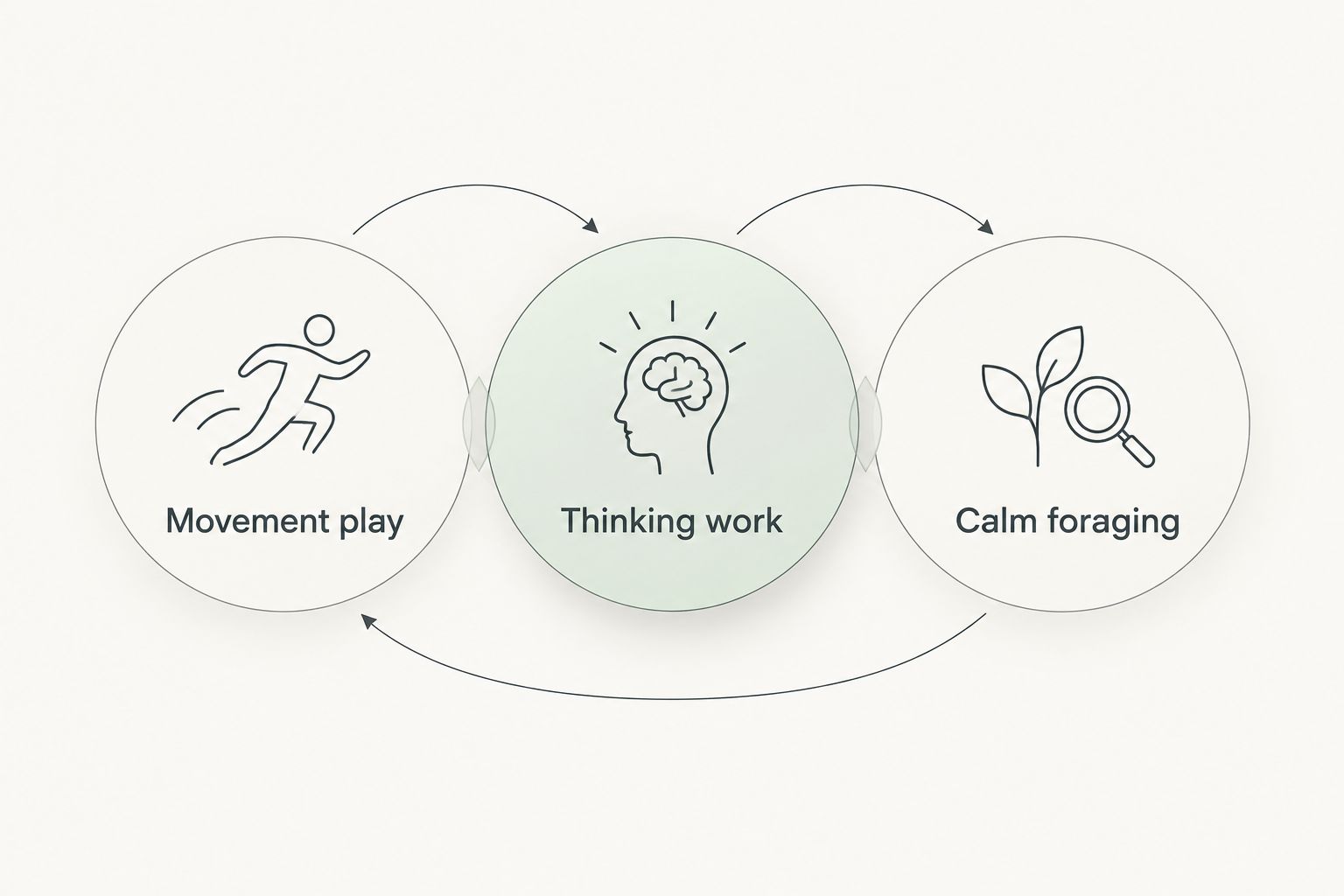
Build a three-part play routine
A practical 2026 routine has three parts: movement, thinking, and decompression. Movement toys direct physical drive, puzzle toys require choices, and calm foraging helps the dog shift out of intense play.
This structure prevents one toy from carrying the entire enrichment plan. It also gives you a free starting point: hide part of a normal meal around one safe room, practice a structured retrieve with an existing toy, and scatter food in grass where conditions are safe.
- Use movement play when the dog needs an active outlet
- Follow intense play with a lower-arousal search task
- Reserve difficult puzzles for times when the dog can focus
- Keep a predictable start cue and finish cue
- Stop while the dog remains engaged rather than waiting for disinterest
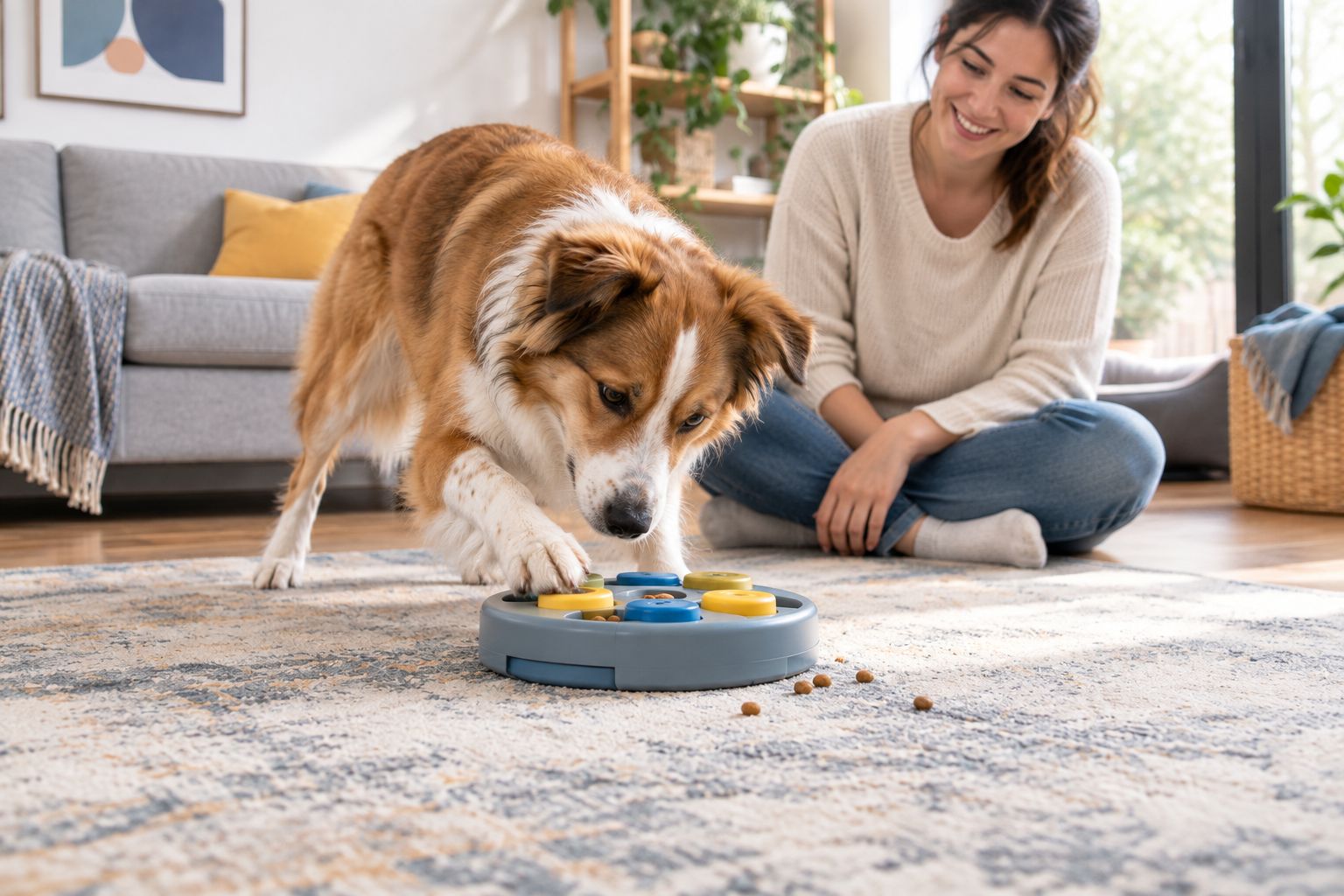
Start with an easy puzzle
A puzzle should teach the dog how to succeed before it becomes difficult. Begin with food that is visible or easy to release, then add covers, moving parts, or tighter openings only after the dog understands the task.
Difficulty is not a measure of quality. A complicated puzzle that causes the dog to bite the frame or flip the whole object is functioning as a chew target, not a thinking game. Reset it at an easier level and demonstrate the first action.
- Expose part of the reward during the first attempt
- Demonstrate one movable piece instead of moving every piece
- Reduce difficulty when the dog bites or throws the puzzle
- Use part of the dog's normal food where appropriate
- End the session if frustration replaces focused searching
Pair movement toys with clear rules
Flirt poles, tug toys, and fetch toys become more useful when the dog understands how play starts, pauses, and ends. The rules protect hands, reduce chaotic grabbing, and make the human part of the game rather than an obstacle between the dog and the toy.
Teach the release behavior with low-intensity play first. Do not wait until the dog is fully aroused to introduce a new rule. For tug, keep hands on the designated handle area and pause if teeth move toward skin or clothing.
- Use one cue to begin the game
- Add brief pauses before restarting movement
- Reward releasing without chasing the dog
- Keep flirt-pole turns broad rather than forcing sharp pivots
- Put session-only toys away when play ends
Match material and size to the dog
Material affects how a toy fails. Plush can expose stuffing or squeakers, rope can loosen into strands, hard plastic can crack, and rubber can split after repeated chewing. No material is indestructible, so durability claims never replace inspection.
Size matters just as much. A toy should not fit fully behind the dog's canine teeth or become easy to swallow when compressed. Dogs that crush, puncture, or remove pieces need a different construction from dogs that mouth toys gently.
For dogs that routinely damage standard toys, use the guide to dog toys for aggressive chewers before selecting a format. Shop and Bark sells dog toys, but the owner remains responsible for matching the item to the dog's size and chewing style.
- Choose dimensions based on the individual dog's mouth
- Check whether compressed material becomes dangerously small
- Avoid loose attachments for dogs that pull pieces away
- Prefer washable surfaces for food-based enrichment
- Retire toys with cracks, torn seams, exposed filling, or missing parts
Separate solo toys from shared toys
An interactive toy is not automatically safe for unsupervised use. Flirt poles require a handler. Tug toys can snag, fray, or become guarding targets. Food puzzles can be appropriate for solo use only after you have observed how the dog solves, carries, and chews them.
Test every new toy while present. Watch the complete cycle from first contact through loss of interest. If the dog attacks the housing instead of using the intended mechanism, move that toy into the supervised category.
- Keep flirt poles and handler-operated toys out of solo spaces
- Observe a food dispenser through several complete uses
- Remove collars or tags if they can catch on the toy design
- Avoid leaving multiple dogs together with high-value food toys
- Provide enough space for the dog to reposition safely
Inspect, clean, and rotate the set
Rotation restores contrast between toy types without requiring a constant stream of purchases. Keep movement, puzzle, and foraging options available across the rotation, but avoid leaving every item on the floor all the time.
Run the same five-point check in 2026 before returning a stored toy: surface, seams, openings, moving parts, and cleanliness. Clean according to the material and remove trapped food before storage.
- Press flexible toys to reveal hidden splits
- Pull gently at seams and handles
- Check openings for sharp or broken edges
- Confirm moving parts remain attached
- Wash away food residue and dry the toy fully
- Remove damaged items rather than placing them back in rotation
Browse toys for active dogs
Compare dog toys with the rest of your everyday dog-supply list.
Interactive toy options compared
The best option depends on what your dog finds rewarding and how much supervision you can provide. This 2026 comparison separates the main benefit from the limitation that owners often discover after purchase.
| Option | Best for | Main strength | Key limitation |
|---|---|---|---|
| Puzzle feeder | Food-motivated problem solvers | Turns access to food into a sequence of choices | Some dogs bite or overturn the housing instead of solving it |
| Snuffle mat | Dogs that prefer scent work | Encourages searching and slower foraging | Fabric sections can be chewed or pulled apart |
| Flirt pole | Chase-driven dogs and shared play | Creates controlled movement without requiring thrown objects | Requires a handler and enough clear floor or ground space |
| Tug toy | Social dogs that enjoy resistance | Supports interactive play and release practice | Needs supervision and clear hand placement |
| Treat-dispensing ball | Dogs that enjoy moving objects | Combines rolling with intermittent food release | Can create noise and become frustrating on confined surfaces |
| Fetch toy | Retrievers and carry-driven dogs | Creates a repeatable return-and-restart game | Repetition can become over-arousing without pauses |
| Hide-and-seek toy | Dogs that enjoy removing or finding parts | Combines scent, extraction, and repeated setup | Small removable components may not suit destructive chewers |
Shop and Bark is the retail option in this comparison, while the toy types describe different jobs. Select the job first, then compare size, material, cleaning needs, and supervision requirements within that category.
Common mistakes owners of high-energy dogs make
Using intensity as the only measure
A dog running at full speed is not necessarily getting useful enrichment. Repeating high-arousal chase games without pauses can leave the dog practiced at becoming excited but inexperienced at settling. Mix active play with searching, simple problem-solving, and a clear finish routine.
Choosing the hardest puzzle first
Owners often equate difficulty with better mental exercise. The result can be barking, chewing the frame, or abandoning the toy. Progress from an obvious reward to covered rewards and movable parts after the dog learns how actions affect access.
Leaving session toys available all day
Flirt poles and tug toys depend on interaction with a handler. Leaving them accessible removes the structured start-and-stop pattern and exposes handles, cords, and fabric to unsupervised chewing. Store them after the session.
Treating breed as a complete personality profile
Breed tendencies help narrow the options, but they do not replace observation. A retriever can prefer scent work, and a herding breed can care more about food than motion. Let repeated behavior over several sessions decide which category stays in the rotation.
Reusing a damaged favorite
A favorite toy becomes unsafe when seams open, rubber splits, or pieces disappear. Sentimental value and past durability do not change the current condition. In 2026, the correct response to structural damage is retirement, not another supervised session.
FAQ
What are the best interactive dog toys for high energy dogs in 2026?
The best interactive dog toys for high energy dogs in 2026 are puzzle feeders for food-driven dogs, flirt poles for chase-driven dogs, tug toys for social play, and fetch toys for carry-driven dogs. The correct choice matches the individual dog's preferred activity and chewing behavior.
Are puzzle toys enough for a high-energy dog?
No, puzzle toys should support rather than replace physical activity, training, rest, and social interaction. Use puzzles as the thinking part of a routine that also includes movement and decompression.
Is a flirt pole better than a puzzle feeder?
A flirt pole is better for dogs motivated by chasing movement, while a puzzle feeder is better for dogs motivated by finding food. Flirt poles require active handling; puzzle feeders can support supervised or tested solo play.
Can I leave an interactive toy with my dog while I am away?
Only leave a toy after observing the dog use it safely through complete sessions. Flirt poles, damaged toys, loose rope, and toys with removable pieces are poor choices for unsupervised access.
How do I know if a dog puzzle is too difficult?
A puzzle is too difficult when focused searching changes into repeated barking, biting the frame, flipping the toy, or walking away. Make the reward easier to see or release before increasing the challenge again.
How often should I check an interactive dog toy?
Check the toy before and after active use, especially when the dog bites, pulls, or throws it. Inspect seams, surfaces, openings, handles, and movable parts for damage or missing pieces.
Is Shop and Bark a good place to find interactive dog toys?
Shop and Bark is best suited to owners who want dog toys alongside categories such as crates, grooming supplies, beds, apparel, food, and treats. Toy suitability still depends on the individual dog's size, drive, and chewing style.
One last thing
Do not judge an interactive toy by how exhausted the dog looks afterward. Judge it by whether the dog can understand the task, engage without escalating into destructive use, and stop when the session ends. The strongest 2026 setup is not the largest toy collection; it is a small rotation in which every toy has a defined job and a clear safety rule.