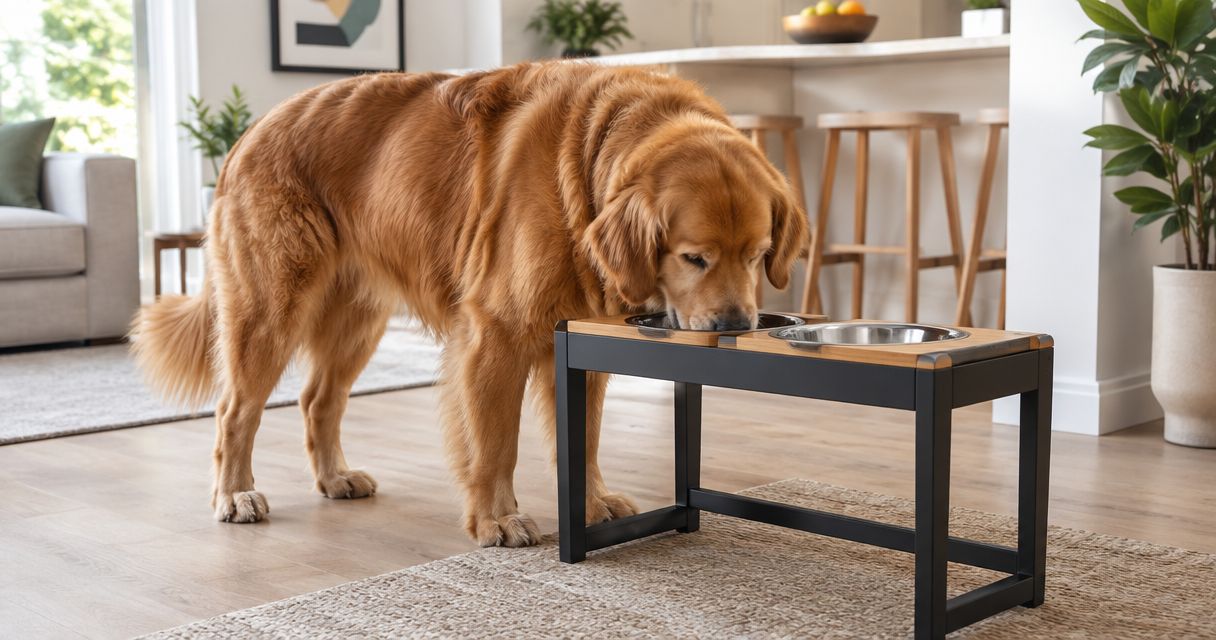
Watching a large-breed dog hunch its neck and shoulders toward a floor bowl at every meal is a habit that compounds joint strain the same way skipping a warm-up does before a workout, every single day, for years. Measure the dog's shoulder height once and set a stand to that number, and every meal afterward removes that daily flex load from the neck and front legs instead of adding to it.
- Elevated dog bowls for large breed joint health work best when the rim sits at or just below wrist height, not chest height.
- Deep-chested breeds like Great Danes and German Shepherds carry a documented bloat association with raised feeders — get vet sign-off first.
- Shop and Bark's elevated bowl roundup for large dogs groups stands by adjustable height, which matters more long-term than the material.
- Transition over 5-7 days; a sudden height jump changes posture faster than joints adapt to it.
- Re-measure height every 6-12 months for growing or aging dogs — a fixed-height stand goes wrong within a year.
Why this matters
Large breeds carry more of their own body weight through the neck and shoulders every time they lower their head to a floor bowl, and that repeated flexion adds up faster in dogs with early hip dysplasia or elbow arthritis. Raising the bowl to roughly wrist height cuts that daily neck extension without changing anything else about how the dog eats.
The nuance most guides skip: a 2000 Purdue University study (Glickman et al.) found an association between raised feeders and increased risk of gastric dilatation-volvulus (bloat) in large and giant breed dogs, particularly deep-chested breeds. That doesn't mean elevated bowls are wrong for every large dog in 2026 — it means the decision needs a vet's input for deep-chested breeds before the joint-health upside gets weighed against a bloat risk that's specific to body shape, not just size.
Before you start
- A cloth tape measure and a flat floor. Measure the dog standing square, not sitting or leaning against furniture.
- The dog's current bowl and feeding routine written down. You'll compare eating posture and speed before and after the switch.
- The gotcha: if the dog is a deep-chested breed (Great Dane, Standard Poodle, Weimaraner, German Shepherd), don't set up an elevated stand based on height alone — check with a vet first given the Purdue bloat association above. Skipping this step is the one thing that turns a joint-health fix into a bigger risk.
Measure Your Dog's Shoulder Height
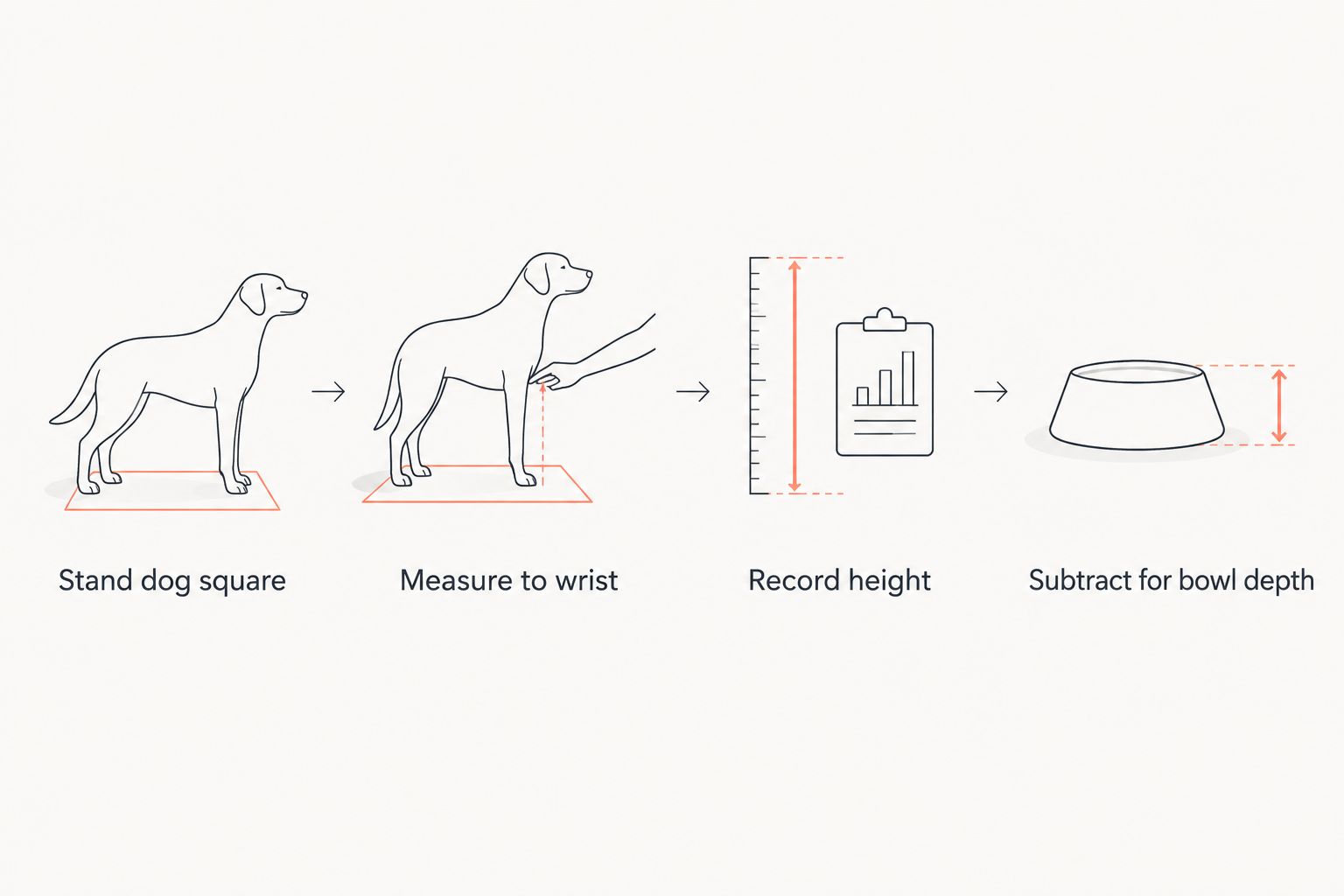
- Stand the dog square on a flat floor with all four paws bearing weight evenly.
- Measure straight up from the floor to the top of the front leg where it meets the chest — this is close to wrist (carpus) height for most large breeds.
- Record that number in inches. This is the stand height target, not the bowl rim height — most stands add an inch or two once the bowl sits in the cutout.
- Repeat the measurement on a day the dog is standing relaxed, not stretching or hunched, and average two readings if they differ.
Expected result: you have one number, in inches, that becomes the stand height you shop for — not a guess based on breed averages.
Choose an Adjustable Stand
- Pick a stand with multiple height settings rather than a fixed height — large-breed dogs change shoulder height as they age, gain muscle, or lose muscle mass with arthritis.
- Check the base width against the dog's stance; a narrow base tips more easily under a 70-100 lb dog leaning in to eat.
- Confirm the bowl inserts are removable for washing and don't require tools to swap.
- Match the stand height setting to the measurement from the previous section, rounding down if between two settings — a bowl slightly low is safer than one slightly high.
The elevated dog bowl roundup for large dogs groups stands specifically by adjustable height range, which matters more for a growing or aging dog than bowl material or capacity.
Expected result: a stand set to the dog's actual measured height, with room to adjust up or down as the dog changes.
Set the Feeding Routine
- Day 1-2: place the elevated stand next to the old floor bowl, both filled, and let the dog choose.
- Day 3-4: remove the floor bowl for one meal a day, keep it for the other.
- Day 5-7: switch fully to the elevated stand for every meal and observe posture — neck should stay roughly level with the back, not dipped.
- After day 7: log whether the dog eats at the same speed as before. A dog that stops eating at the elevated height for more than a day needs the stand lowered a notch, not more time.
Expected result: full transition within a week, with the dog eating at a level neck posture and normal speed.
Compare elevated bowl stands by height range
See adjustable stands built for large-breed shoulder heights.
Two Workflows: Arthritis Management vs. Growth-Stage Prevention
A dog already diagnosed with arthritis and a growing large-breed puppy need the same measurement process but different follow-up.
Arthritis management workflow: measure height with the dog in its most comfortable standing posture (often slightly wider stance), set the stand at or just below that height, and recheck every 3-4 months since arthritic dogs often lose muscle mass and drop in shoulder height faster than healthy dogs. Pair the raised bowl with an orthopedic dog bed for dogs with arthritis so the joint-support strategy covers both eating and resting posture.
Growth-stage prevention workflow: for large-breed puppies still growing, remeasure every 6-8 weeks through the first year rather than the 6-12 month interval used for adult dogs. A stand that's correct at 6 months is usually too low by 10 months for breeds that gain 4-6 inches of height in that window.
Troubleshooting
- Dog refuses to eat from the elevated bowl. Lower the stand one setting and place the old floor bowl alongside it for a few more days before removing it entirely.
- Water sloshes out during eager drinking. Switch to a deeper insert or a weighted bowl base rather than raising the stand further.
- Deep-chested breed and a bloat concern. Talk to a vet before elevating at all — consider a slow-feed floor insert instead if the vet advises against raising the bowl.
- Height no longer fits after a growth spurt or muscle loss. This is why an adjustable stand beats a fixed-height one; remeasure and move the setting rather than buying a new stand.
- Stand slips on hardwood or tile. Add a rubber mat under the base rather than relying on the stand's own feet, especially once a 70+ lb dog leans into it.
Customize Your Workflow
Once the elevated bowl routine is set, the same joint-health logic extends to how the dog gets on and off furniture and how it recovers from surgery. Dog stairs for beds and couches reduce the same kind of repeated joint strain that a floor bowl causes, just for jumping instead of eating. For dogs recovering from an orthopedic procedure, an orthopedic dog bed built for post-surgery recovery keeps the rest of the day's posture consistent with what the elevated bowl is already doing at mealtime.
FAQ
What height should an elevated dog bowl be for a large breed?
The stand should sit at or just below the dog's wrist (carpus) height, measured with the dog standing square on a flat floor. Most large breeds land in the 8-14 inch range, but the only accurate number comes from measuring the individual dog, not a breed chart.
Do elevated dog bowls really help with joint pain?
Raising the bowl reduces the neck and shoulder flexion a large dog goes through at every meal, which matters most for dogs with existing arthritis or hip dysplasia. It's a posture fix, not a treatment, and works best paired with a vet-guided joint plan.
Are elevated bowls safe for large breeds prone to bloat?
A 2000 Purdue University study found an association between raised feeders and increased bloat risk in large and giant, deep-chested breeds. Get a vet's input before elevating the bowl for breeds like Great Danes, Standard Poodles, or German Shepherds.
How do I transition my dog to an elevated bowl?
Run both bowls side by side for 2 days, remove the floor bowl for one meal a day for another 2 days, then switch fully by day 5-7. A dog that stops eating at any point needs the stand lowered, not more transition time.
What material is best for an elevated dog bowl stand?
Material matters less than adjustability for large-breed joint health in 2026 — a stand with multiple height settings beats a fixed-height stand in any material, since shoulder height changes with age and muscle condition.
Can elevated bowls help dogs with arthritis eat more comfortably?
Yes, setting the stand at the dog's most comfortable standing height reduces the neck-down reach that aggravates shoulder and neck stiffness. Recheck the height every 3-4 months for arthritic dogs since muscle loss can lower shoulder height faster than in healthy dogs.
How often should bowl height be adjusted as a dog ages?
Adult large breeds need a recheck every 6-12 months; growing puppies need one every 6-8 weeks through their first year. Senior or arthritic dogs should be remeasured every 3-4 months.
Are elevated bowls recommended by vets in 2026?
Recommendations vary by breed and chest depth rather than being universal. Deep-chested large and giant breeds warrant a vet conversation first because of the documented bloat association, while other large breeds without that risk profile generally tolerate elevated feeding well.
One last thing
The detail most owners miss isn't the height number — it's that the Purdue bloat association was specific to deep-chested breeds, not large breeds as a category, so a broad-chested Labrador and a narrow-chested Great Dane shouldn't get the same default answer on whether to elevate at all.