Leave a puppy loose in an unfamiliar house and you'll spend the first two weeks chasing chewed cords, mopping accidents, and losing sleep over every unsupervised minute. Instead of babyproofing the entire house at once, set up a dog playpen as the control zone first, then expand the puppy-proofed area room by room as the puppy earns freedom.
- A dog playpen creates a contained, chew-safe zone in under an hour and removes the need to puppy-proof the whole house on day one.
- Shop and Bark's playpen picks work for the exercise-pen stage; pair with a crate for overnight routines.
- Expand supervised floor time in 3-5 day increments once the puppy stops testing the pen barrier.
- Escape attempts and chewed panels are the two most common failure points in the first week of 2026 puppy setups.
- Move from playpen to full-home access only after the puppy has 48 hours of accident-free supervised time.
Why this matters
Most puppy-proofing advice tells you to remove every hazard from every room before the puppy comes home. That's a two-day project most people don't finish, and puppies arrive anyway.
A dog playpen flips the order: you proof one small zone completely, put the puppy there when you can't watch it, and expand the safe territory in stages instead of all at once. This is how professional breeders and trainers manage the first 8-12 weeks, and it's the fastest path to a puppy-proofed home that doesn't require a weekend of baby gates and outlet covers before the puppy even steps through the door.
Before you start
- A playpen sized for the breed's adult height, not current size — an 8-week-old Lab puppy will clear a 24-inch panel by 14 weeks if you buy for the puppy in front of you instead of the dog it's becoming.
- A washable floor surface underneath — hardwood and pens with exercise-pen flooring don't grip together, and a sliding pen panel during a play session is how puppies get out.
- The gotcha: most exercise pens ship with plastic zip-tie style connectors between panels, and puppies figure out how to push a corner joint apart within days. Reinforce every corner with a carabiner or the pen's included J-clips before the first unsupervised session, not after you find a gap.
Set up your playpen zone
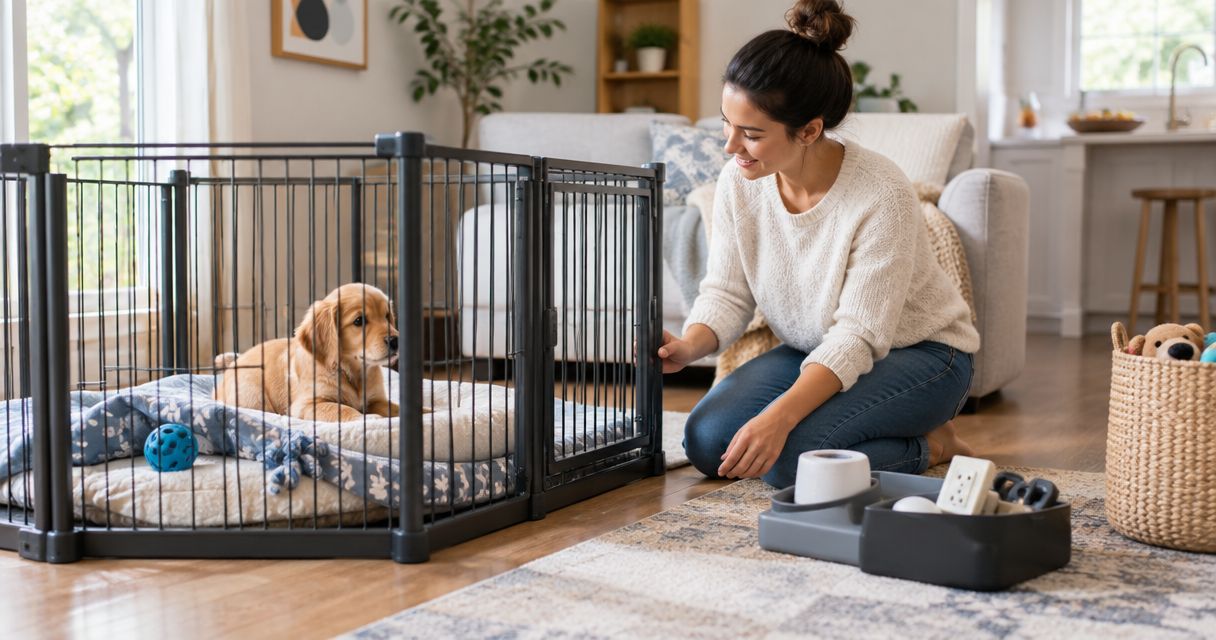
- Pick a room with a hard floor — kitchen, laundry room, or tiled entryway. Carpet holds odor from accidents and slows potty training.
- Set the playpen panels in a shape that puts a corner against a wall, not free-standing in the middle of the room. A wall-anchored corner removes one full side of tipping risk.
- Lock every panel connector, then push on each seam with your hand at puppy-shoulder height to confirm nothing flexes.
- Lay a washable pad or puppy pad zone on one side of the pen, away from the water bowl and bed — puppies won't toilet where they sleep or eat if the pen is large enough to separate the two.
- Place a chew-safe toy and a low-sided water bowl inside. Skip anything with small parts, stuffing, or squeakers a new puppy could tear open in the first sitting.
Expected result: the puppy can move freely inside the pen, has a clear potty zone separate from sleeping and eating areas, and none of the panels shift when nudged.
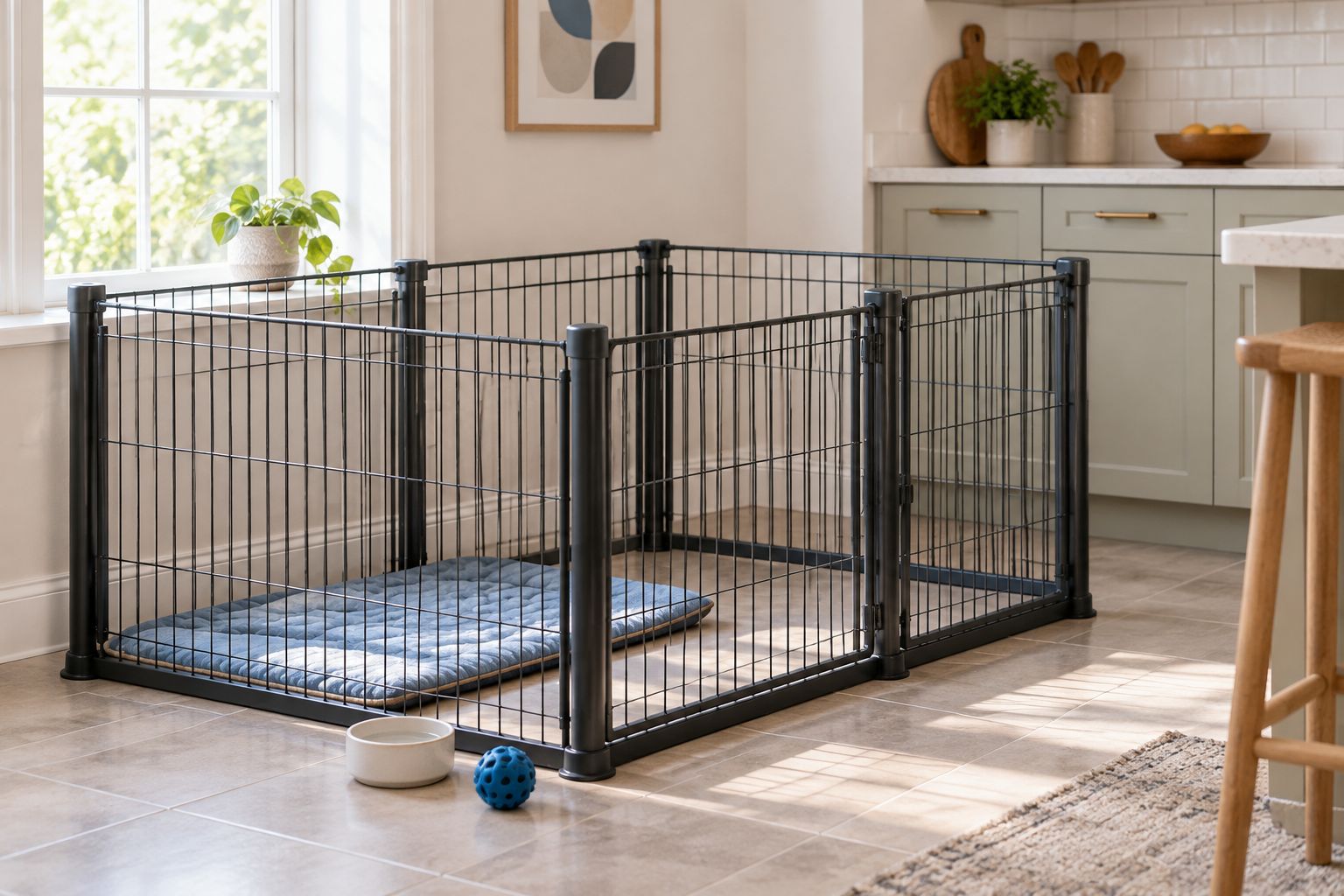
Configure the puppy-proofed perimeter
- Walk the full perimeter of the pen at floor level and remove anything within nose or paw reach through the bars — cords, rugs corners, shoes, houseplants.
- Check the gap under any furniture near the pen. Puppies squeeze under couches and coffee tables that look too low to matter.
- Cover or relocate outlets within 6 inches of the pen's outer edge. Puppies chew through the bars if something interesting sits just outside them.
- Set a visual boundary on the floor with painter's tape 3 feet out from the pen on all open sides, marking the zone where supervised play will eventually happen.
- Test the setup by sitting outside the pen for 15 minutes without intervening. Note every spot the puppy paws at, chews on, or tries to climb.
Expected result: a pen perimeter with zero reachable hazards and a documented list of the 2-3 weak points the puppy already found, which is what step four of the next section fixes.
From pen to free-roam: the expansion workflow
Once the puppy has gone 48 hours without an accident and without a serious escape attempt, move the boundary out instead of tearing it down.
- Open one pen panel to connect to a hallway or single adjoining room, using the same panels as a gate instead of a full enclosure.
- Puppy-proof that new room using the same perimeter check from the section above — cords, gaps under furniture, reachable objects.
- Supervise the expanded zone for 3-5 days before opening the next room. Rushing this step is the single most common reason puppies regress on potty training.
- When the puppy is reliably choosing its own potty pad or asking to go outside from two rooms away, retire the pen to nighttime and crate-adjacent use only.
This is also the point where most owners layer in crate training alongside the playpen — the crate covers overnight and travel, the pen covers daytime containment, and together they cover more hours than either does alone.
One quotable rule: if the puppy hasn't tested the pen's weak points in 48 hours, it's ready for one more room — not the whole house.
“If the puppy hasn't tested the pen's weak points in 48 hours, it's ready for one more room, not the whole house.”
Troubleshooting
- Puppy chews the pen bars or panel joints. Redirect immediately to an appropriate chew item — a pen full of soft toys won't satisfy a teething puppy the way toys built for aggressive chewers will, and those hold up better against panel gnawing too.
- Puppy climbs or scales the pen. The pen height is under-sized for the breed. A 24-inch pen holds a 10-week-old puppy and fails within a month for most medium and large breeds.
- Accidents happen outside the marked potty zone inside the pen. The pen is too small to separate sleeping, eating, and toileting areas. Add panels to increase floor space rather than moving the pad closer to the bed.
- Puppy screams or barks the entire time it's penned. Check duration first — a puppy under 12 weeks shouldn't be penned alone for more than 60-90 minutes at a stretch without a supervised break.
- Puppy pulls up the floor pad or tarps underneath. Weight the corners with the water bowl or a heavy toy, or switch to a pad with adhesive backing rated for pet use.
Customize your workflow
A playpen setup isn't a one-time project — it scales as the puppy's needs change. Owners who commute with the dog often extend the same containment logic to the car with a dog car safety barrier, which uses the identical principle of a controlled zone the dog can't breach mid-drive.
By 2026, most trainers treat the pen-to-house workflow as a 4-6 week process for an average puppy, not a weekend project. Owners who rush the expansion stage see more regressions than owners who add one room every 3-5 days.
Find the right playpen for your puppy
Compare pen sizes and panel styles built for the puppy-proofing stage.
FAQ
How do I puppy proof with a playpen?
Set the playpen against a wall corner on a hard floor, remove every reachable hazard through the bars, and lock every panel joint before leaving the puppy unsupervised. Expand the puppy-proofed zone one room at a time only after 48 hours without an accident or escape attempt.
What size playpen does a puppy need?
Size the pen for the breed's adult shoulder height, not its current size, since puppies clear undersized panels within weeks. A pen that fits a Labrador at 8 weeks is often too short by 14 weeks.
Is a playpen better than a crate for a new puppy?
A playpen and a crate serve different hours of the day rather than competing with each other. The pen covers daytime containment with room to move, while the crate handles overnight sleep and travel.
How long can a puppy stay in a playpen?
A puppy under 12 weeks shouldn't be penned alone for more than 60-90 minutes at a stretch without a supervised break to eat, play, or go outside.
How do I stop a puppy from chewing the playpen bars?
Redirect the puppy to an appropriate chew toy the moment it starts gnawing on a panel, and keep a durable chew item inside the pen at all times during the teething stage.
When can a puppy move from a playpen to the whole house?
Most puppies are ready for full-home access after a 4-6 week expansion process in 2026, adding one puppy-proofed room every 3-5 days once accidents and escape attempts stop.
Why does my puppy scream in the playpen?
Screaming usually means the session is too long for the puppy's age or the pen is too small to separate rest, play, and potty areas. Shorten sessions first before assuming it's separation anxiety.
Can I use a playpen outdoors for puppy proofing?
Yes, as long as the surface is stable and shaded, and the same perimeter check applies — remove reachable plants, cords, and gaps under nearby furniture or structures.
One last thing
The pen's weak points don't move once you've found them in the first 15-minute test sit — a puppy that pawed at the same corner on day one will keep testing that exact spot for weeks, so reinforce it once and stop rechecking the rest of the perimeter every day.