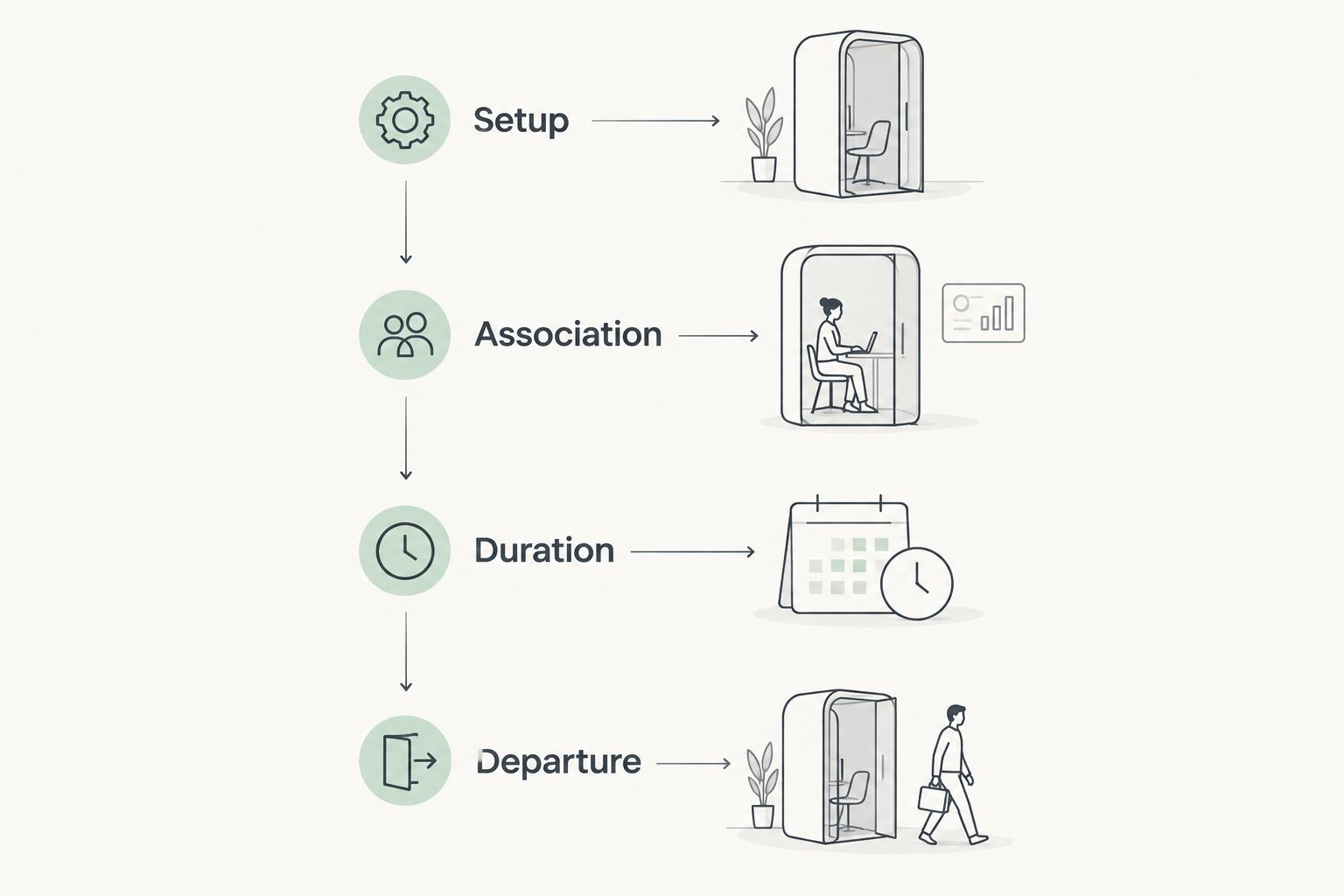
Crate training fails when it's treated as a cage sentence instead of a routine — a dog forced into a box for eight hours on day one panics, and a family that gives up after one bad night never gets a second chance. Instead of improvising each day, run a structured workflow: set the crate up correctly once, layer in short positive sessions, then stretch duration and add departures in a fixed order so the dog never hits a stress point it hasn't already handled in a smaller dose.
Shop and Bark sells crates, playpens, and crate furniture for exactly this reason — the hardware only works if the sequence around it is right.
- A dog crate training workflow works in four fixed phases: setup, association, duration, and departure — skipping ahead is the most common failure point in 2026 intake surveys from trainers.
- Puppies 8-16 weeks old can generally hold their bladder about one hour per month of age; plan crate stretches around that, not around your schedule.
- Adult rescue dogs and puppies need the same four phases but different pacing — rescues often need days at Phase 1, puppies days at Phase 3.
- A crate covered on three sides settles a dog faster than an open wire crate because it mimics a den, not a display case.
Why This Matters
Most crate training advice online skips straight to "put the dog in the crate and ignore the crying," which works for maybe one dog in ten and traumatizes the other nine. The dogs that struggle aren't broken — they were rushed through a sequence that needed to be slower.
A proper dog crate training workflow in 2026 treats the crate as a trigger-and-response system: each phase has an entry condition and an exit condition, and you don't move to the next phase until the current one is boring for the dog. Boring means calm. Calm means it's working.
The dogs that crate-train successfully in 2 to 3 weeks are the ones whose owners refused to skip a phase, not the ones with the most expensive crate.
Before You Start
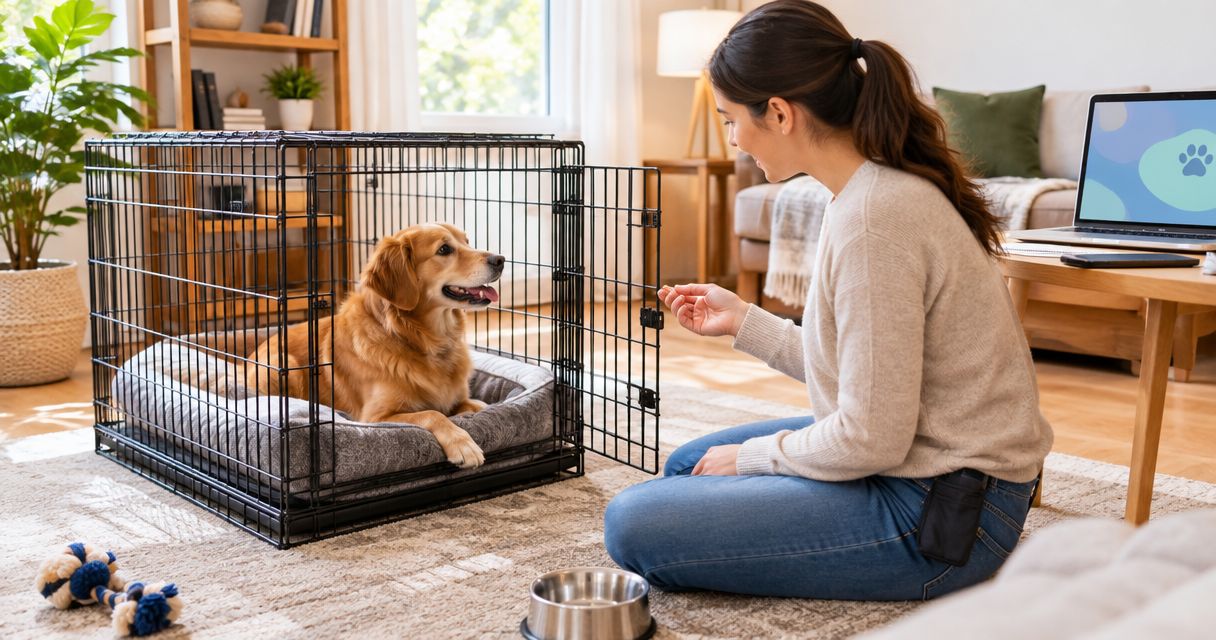
- A correctly sized crate. The dog should stand without ducking, turn in a full circle, and lie flat — no more room than that, or a puppy will use the extra space as a bathroom corner.
- High-value treats reserved only for the crate. Not the everyday kibble-based treat — something the dog doesn't get anywhere else, so the crate becomes the only place that food shows up.
- The gotcha that undoes week one: never crate a dog that hasn't just been given a bathroom break. One accident inside the crate teaches the dog the crate isn't a clean space, and that single mistake can cost you 3-4 days of retraining trust.
Set Up the Crate Zone
- Place the crate in a low-traffic corner of a room the family actually uses — not a basement or garage. Isolation defeats the point of a den.
- Remove the door temporarily, or prop it open, for the first 48 hours. The dog needs to explore on its own terms before the door ever closes.
- Line the floor with a washable pad, not bedding the dog can shred and ingest.
- If the crate is wire, cover three sides with a breathable blanket. Wire crates read as open cages to a dog; covered ones read as dens.
Expected result: the dog walks in and out of the open crate voluntarily within the first day or two, without being lured every time.
Apartment owners running this setup in tight square footage should look at dog crate furniture for small apartments before buying — a crate that doubles as an end table solves the low-traffic-corner problem when there isn't a spare corner.
Build the Positive-Association Trigger
- Toss a treat inside the crate every time the dog walks near it, door still open. Don't say a command yet — this step is pure association, not obedience.
- Feed one full meal a day inside the crate, door open, for 3-5 days straight.
- Once the dog eats calmly with the door open, close the door during the meal and open it the second the bowl is empty.
- Add a single verbal cue — "crate" or "kennel" — right as the dog enters, every single time, so the word and the action bond.
Expected result: the dog enters the crate on the verbal cue alone, without a treat lure, by the end of this phase.
Configure the Duration and Departure Trigger
- With the dog fed and calm inside, close the door and sit in the room for 2 minutes. Release before any whining starts, not after.
- Extend to 5, then 10, then 20 minutes over several sessions, always ending the session while the dog is still quiet.
- Once the dog holds 20+ minutes calmly with you in the room, leave the room for 60 seconds and return before you'd expect any reaction.
- Stretch your absence in the same increments — 2 minutes, then 5, then 15 — always returning while the dog is silent.
Expected result: the dog tolerates a full room-empty absence of 15-20 minutes without vocalizing, which is the threshold most trainers use before leaving the house for real errands.
Puppy Workflow vs. Adult Rescue Dog Workflow
The four phases are identical for both, but the pacing and the failure risks are different enough to plan around separately.
| Factor | Puppy (8-16 weeks) | Adult rescue dog |
|---|---|---|
| Typical time in Phase 1 (Setup) | 1-2 days | 3-7 days — past trauma with confinement is common |
| Bladder/duration limit | About 1 hour per month of age | Usually 4-6 hours once house-trained |
| Biggest risk | Accidents inside the crate reset trust | Panic or destruction from prior negative crate history |
| Best for | Owners starting from zero with a blank-slate dog | Owners re-teaching a dog that already associates crates with shelters or crates gone wrong |
Verdict: puppies move through Phase 2 and 3 faster because they have no baggage; rescue dogs need extra weeks at Phase 1 and should never be rushed into a closed door in the first week. Multi-dog households running this workflow with more than one crate at once should check dog crate furniture for multi-dog households — stacking or spacing crates wrong is a common reason one dog in the house never settles.
Troubleshooting
- Dog whines the instant the door closes. You moved to a closed door too fast. Go back to open-door meals for another 2-3 days before trying the door again.
- Dog won't enter even with treats. Something in the environment is aversive — check for a draft, a loud appliance nearby, or a crate placed directly under a vent.
- Accidents happen inside a properly sized crate. Rule out a medical issue first (urinary tract infection is common in puppies and older dogs), then check that bathroom breaks are happening on the schedule the crate demands, not the schedule you'd prefer.
- Dog is fine at night but panics during daytime departures. Nighttime crating works because the house is quiet; daytime absences often need a slower Phase 4 with shorter, more frequent departures rather than long ones.
- Dog destroys bedding or the crate pad. Remove soft bedding entirely during the association phase — some dogs chew from anxiety, and a bare, washable pad removes the target.
Customize Your Workflow
Once the crate routine holds for 20+ minutes of solo time, most owners layer in a second containment tool for daytime hours when the dog doesn't need to be fully confined — a dog playpen gives more room while keeping the same boundary logic the crate taught.
If the workflow needs to extend into the car, the same trigger-and-release logic applies to vehicle safety. The car safety barrier install guide walks through the equivalent setup for travel containment, and dogs that already accept a crate boundary generally accept a car barrier faster.
Shop crates and containment gear
Browse crates, playpens, and crate furniture sized for the workflow above.
FAQ
What is the fastest dog crate training workflow?
The fastest reliable workflow runs four phases in order — setup, association, duration, departure — and most dogs complete it in 2 to 3 weeks in 2026 trainer estimates. Skipping a phase to save time usually adds a week back through setbacks.
How long can a puppy stay in a crate?
A puppy can generally hold its bladder about one hour per month of age, so an 8-week-old puppy needs a break roughly every 2 hours. Overnight is an exception once the puppy is past 4-5 months, since metabolism slows during sleep.
Is crate training cruel?
Crate training is not cruel when the crate is sized correctly and never used longer than the dog's age or training stage supports. It becomes a problem only when a crate is used as punishment or for durations well beyond what the dog can handle.
Should I cover the dog crate at night?
Covering three sides of a wire crate with a breathable blanket helps most dogs settle faster because it mimics an enclosed den. Leave one side uncovered for airflow, and skip the cover entirely in warm rooms.
How do I stop a dog from crying in the crate?
Crying almost always means you moved to a longer duration or a closed door too fast — go back one step in the workflow and hold there longer. Releasing the dog while it's crying teaches it that crying works, so always release during a quiet moment instead.
Can an adult rescue dog be crate trained?
Yes, adult rescue dogs can be crate trained using the same four-phase workflow, though Phase 1 often takes 3-7 days instead of 1-2 because of prior negative associations. Rushing a rescue dog into a closed door in week one is the most common reason crate training fails with adopted dogs.
What size crate does my dog need?
The dog should be able to stand without ducking, turn in a full circle, and lie flat with no extra room to spare. Extra space in a puppy crate gets used as a bathroom corner, which undoes housetraining progress.
One Last Thing
Dogs are den animals by instinct, which is why an open wire crate — the kind that looks the most "comfortable" to a human — is often the slowest crate type to get a dog to settle in. Covering it turns an open cage into an enclosed space the dog treats like shelter instead of display. That single change, more than any treat or command, is what shortens the association phase for hesitant dogs.