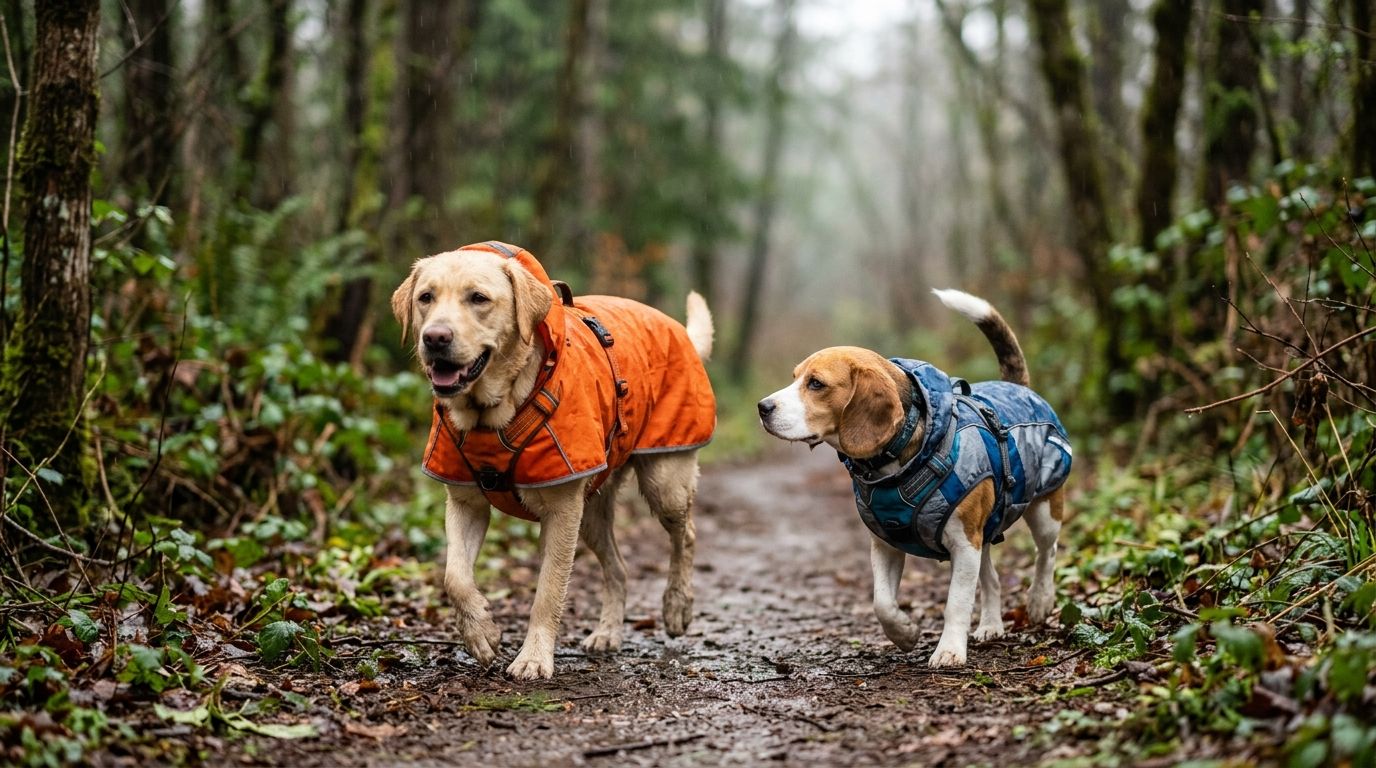
Choosing the best dog raincoats and windbreakers in 2026 comes down to one question: what kind of wet does your dog actually walk in? A dachshund squatting in ankle-deep puddles needs different coverage than a Lab shaking off a light drizzle on a 20-minute loop.
- A full-coverage PU-coated raincoat with a harness port is the best overall pick for daily wet-weather walks in 2026.
- Fleece-lined windbreakers win for cold, dry-but-windy conditions where insulation matters more than waterproofing.
- Long-body coats fit dachshunds, corgis, and basset hounds better than standard-cut raincoats.
- Reflective raincoats are the safer default for early-morning or after-dark walks in low visibility.
- A poncho-style slicker covers the budget slot without sacrificing basic waterproofing.
Why this matters
A raincoat that soaks through at the shoulders or rides up over the belly doesn't protect anything — it just adds a wet layer your dog has to dry off later. Rain and wind exposure also matters for short-haired and small breeds, whose smaller body mass loses heat faster than a Golden Retriever's.
The right dog raincoats and windbreakers for 2026 depend on three variables: your dog's coat type, your climate (coastal drizzle versus Midwest downpours), and how the coat interacts with a harness. Get that wrong and the coat sits in a closet after week two.
If you're also sorting out walking gear, the best no-pull dog harnesses roundup covers which harness styles play nicely with a raincoat's back opening — worth checking before you buy either one in isolation.
What makes the best dog raincoat or windbreaker
- Waterproof material — PU-coated nylon sheds rain; basic water-resistant nylon only slows it down.
- Harness compatibility — a back slit or D-ring cutout so the coat doesn't bunch under a harness strap.
- Belly and leg coverage — splash-back from wet pavement soaks the underside more than the top.
- Closure system — velcro or snap closures that a wet, wiggling dog can't shake loose mid-walk.
- Fit range — chest girth and back-length sizing that actually maps to real breeds, not just S/M/L guesses.
- Visibility — reflective trim or piping for dark mornings and early sunsets, which start creeping in by October in most of the US.
Best dog raincoats and windbreakers in 2026: at a glance
| Style | Best for | Standout feature | Key limitation |
|---|---|---|---|
| Full-coverage PU raincoat | Daily wet-weather walks | Harness port + belly flap | Bulkier to store or pack |
| Fleece-lined windbreaker | Cold, dry, windy days | Insulation without full waterproofing | Soaks through in sustained rain |
| Packable lightweight shell | Travel and unpredictable weather | Folds into a pocket-size pouch | Thin material, less durable long-term |
| Reflective raincoat | Early-morning or night walks | High-visibility piping or trim | Reflective strips fade with repeated washing |
| Long-body coverage coat | Dachshunds, corgis, long-backed breeds | Extended torso length | Doesn't fit standard-proportioned breeds |
| Poncho-style rain slicker | Budget-conscious buyers | Simple slip-on design | No leg coverage, minimal structure |
1. Full-coverage PU raincoat: best dog raincoat for daily wet-weather walks
A PU-coated (polyurethane) raincoat is the standard for genuine waterproofing — the coating creates a sealed layer rather than just repelling light moisture. Look for a hydrostatic head rating around 5,000mm or higher, which is the general textile-industry threshold where a fabric is considered reliably waterproof rather than just water-resistant. Most versions built for dogs add a belly flap and a cutout or slit over the shoulders so a harness clips through without bunching the fabric.
Full-coverage PU raincoat pros:
- Genuinely waterproof in sustained rain, not just drizzle
- Belly flap cuts down on splash-back soaking the underside
- Harness port means you don't have to choose between the coat and the leash setup
Full-coverage PU raincoat cons:
- Bulkier than a windbreaker, less packable for travel
- Can trap heat on milder days if there's no ventilation panel
Verdict: Buy — if you only own one dog raincoat in 2026, this is the style that earns its closet space.
2. Fleece-lined windbreaker: best for cold, dry, windy days
Windbreakers aren't raincoats — they're built to cut wind chill on cold, dry days when the real problem is temperature, not moisture. A fleece or brushed-poly lining adds warmth without the bulk of an insulated winter coat, which matters for short-haired breeds standing around at the dog park in January.
Fleece-lined windbreaker pros:
- Lightweight and breathable compared to a full raincoat
- Fleece lining adds real warmth on cold mornings
- Easier on-and-off than a structured raincoat
Fleece-lined windbreaker cons:
- Not waterproof — soaks through in anything beyond light mist
- Doesn't cover the belly or legs the way a full raincoat does
Verdict: Buy — for dry-cold climates, but pair it with a proper raincoat if your area gets real rain too.
3. Packable lightweight shell: best for travel and unpredictable weather
A packable shell is thin nylon, sometimes with a light DWR (durable water repellent) coating rather than full PU lamination. It folds into a stuff sack small enough to live in a glovebox or daypack, which matters when you're traveling and the forecast is a coin flip.
Packable shell pros:
- Folds to fit in a bag or car door pocket
- Good backup layer for surprise showers on a hike
- Usually lighter than a structured raincoat, so less restrictive for active dogs
Packable shell cons:
- Thinner material wears out faster with regular use
- Not built for sustained downpours — DWR coatings wear off after repeated washing
Verdict: Hold — buy this as a second, travel-specific coat rather than your dog's primary rain layer.
4. Reflective raincoat: best for early-morning and night walks
Sunset creeps earlier by late fall across most of the US, and rain plus low light is the combination that makes a dog hardest to spot from a car. A reflective raincoat adds piping, trim, or a full reflective panel that catches headlights, on top of whatever waterproofing the base fabric provides.
Reflective raincoat pros:
- Meaningfully improves visibility on dark or foggy walks
- Often combines reflective trim with standard PU waterproofing
- Doubles as a safety layer even on dry, dark evenings
Reflective raincoat cons:
- Reflective strips lose brightness after repeated machine washing
- Premium reflective trim usually costs more than a basic raincoat of the same cut
Verdict: Buy — non-negotiable if your walk schedule includes dawn or dusk, rain or not.
5. Long-body coverage coat: best for dachshunds, corgis, and long-backed breeds
Standard raincoat sizing is built around a fairly average torso-to-leg ratio, which leaves long-backed breeds exposed at the lower back and hindquarters. A long-body coat adds extra torso length so the coverage actually reaches where these breeds get wet first.
Long-body coat pros:
- Covers the lower back and hips that standard cuts miss on long breeds
- Reduces the mud-streak-up-the-back problem after a wet walk
- Usually available with the same harness-port and closure options as standard raincoats
Long-body coat cons:
- Fit is breed-specific — a long-body coat looks oversized and sloppy on a standard-proportioned dog
- Fewer style and color options than mainstream raincoat cuts
Verdict: Buy — if you own a dachshund, corgi, or basset hound, this is the only cut worth considering.
6. Poncho-style rain slicker: best budget option
A poncho-style slicker is the simplest cut: a slip-on shell with a hole for the head and sometimes the front legs, no full harness integration. It's the budget entry point into rain gear and works fine for short bathroom-break walks in light rain.
Poncho-style slicker pros:
- Fastest on-and-off of any style on this list
- Lightest option, good for quick trips outside
- Simple design means fewer straps and buckles to fight with a wet dog
Poncho-style slicker cons:
- No leg coverage, so paws and lower legs still get soaked
- Minimal structure means it shifts around on active dogs
Verdict: Wait — fine as a stopgap, but a dog walked daily in real rain outgrows this style fast.
“If the coat doesn't cover the belly, you haven't bought a raincoat -- you've bought a bib.”
How this list was ranked
Each style was scored against the six criteria above: waterproof material, harness compatibility, coverage, closure security, fit range, and visibility. No single coat wins on every axis in 2026 — a fleece windbreaker will never out-waterproof a PU shell, and a full raincoat will never pack as small as a lightweight travel shell. The ranking reflects which criteria matter most for which use case, not a single leaderboard.
Which dog raincoat or windbreaker should you choose in 2026?
For most owners walking a dog daily through unpredictable weather, the full-coverage PU raincoat with a harness port is the default buy — it's the only style that handles sustained rain and integrates with a harness without bunching. Add a reflective raincoat or reflective trim if any of your walks happen before sunrise or after sunset. Long-backed breeds should skip standard cuts entirely and go straight to a long-body coat, and a windbreaker earns its spot as a second coat for cold-but-dry days rather than a rain replacement.
Once the coat's sorted, a few dogs still hate the actual putting-on process more than the rain itself — that's a training issue, not a gear issue, and a best interactive dog toys for bored dogs guide has ideas for keeping a dog occupied on the days rain cancels the walk entirely.
Browse dog rain gear at Shop and Bark
Apparel, harnesses, and grooming supplies in one place.
A wet dog dragged in from a rainstorm also needs a fast, thorough dry-off before it curls up on furniture — the best dog grooming supplies for home grooming list covers towels and dryers built for exactly that.
FAQ
What is the best dog raincoat for heavy rain in 2026?
A full-coverage PU-coated raincoat with a belly flap and harness port is the best option for heavy, sustained rain in 2026. Look for a hydrostatic head rating around 5,000mm or higher for genuine waterproofing rather than basic water resistance.
Is a dog windbreaker the same as a raincoat?
No. A windbreaker cuts wind chill on cold, dry days but isn't built to handle sustained rain, while a raincoat uses a waterproof or PU-coated shell specifically to shed water.
Do dog raincoats work with harnesses?
Only coats built with a back slit, D-ring cutout, or harness port work cleanly with a harness. Standard coats without this feature bunch up under harness straps and reduce coverage.
What size raincoat does a dachshund need?
Dachshunds and other long-backed breeds need a long-body coat cut rather than a standard raincoat, since standard sizing leaves the lower back and hips exposed on long-torsoed dogs.
Are reflective dog raincoats worth it?
Yes, if any walks happen at dawn, dusk, or after dark. Reflective trim or piping meaningfully improves visibility from a driver's perspective, though the reflective brightness fades with repeated washing.
Can a dog wear a raincoat every day?
Yes, as long as the coat fits properly and doesn't restrict movement or trap excess heat. Rotate between a full raincoat for wet days and a windbreaker for dry, cold days rather than using one coat for every condition.
How do I stop a dog raincoat from sliding around?
Choose a coat with a secure velcro or snap closure at the chest and belly, not just a slip-on poncho style. A properly sized coat with two points of closure stays in place far better than a single-strap design.
One last thing
Most owners size a raincoat off the dog's weight chart on the packaging and skip the chest-girth measurement entirely — that's the single biggest reason coats end up too tight at the shoulders or flapping loose at the belly. Measure chest girth with a soft tape before buying in 2026, not after the first coat gets returned.