
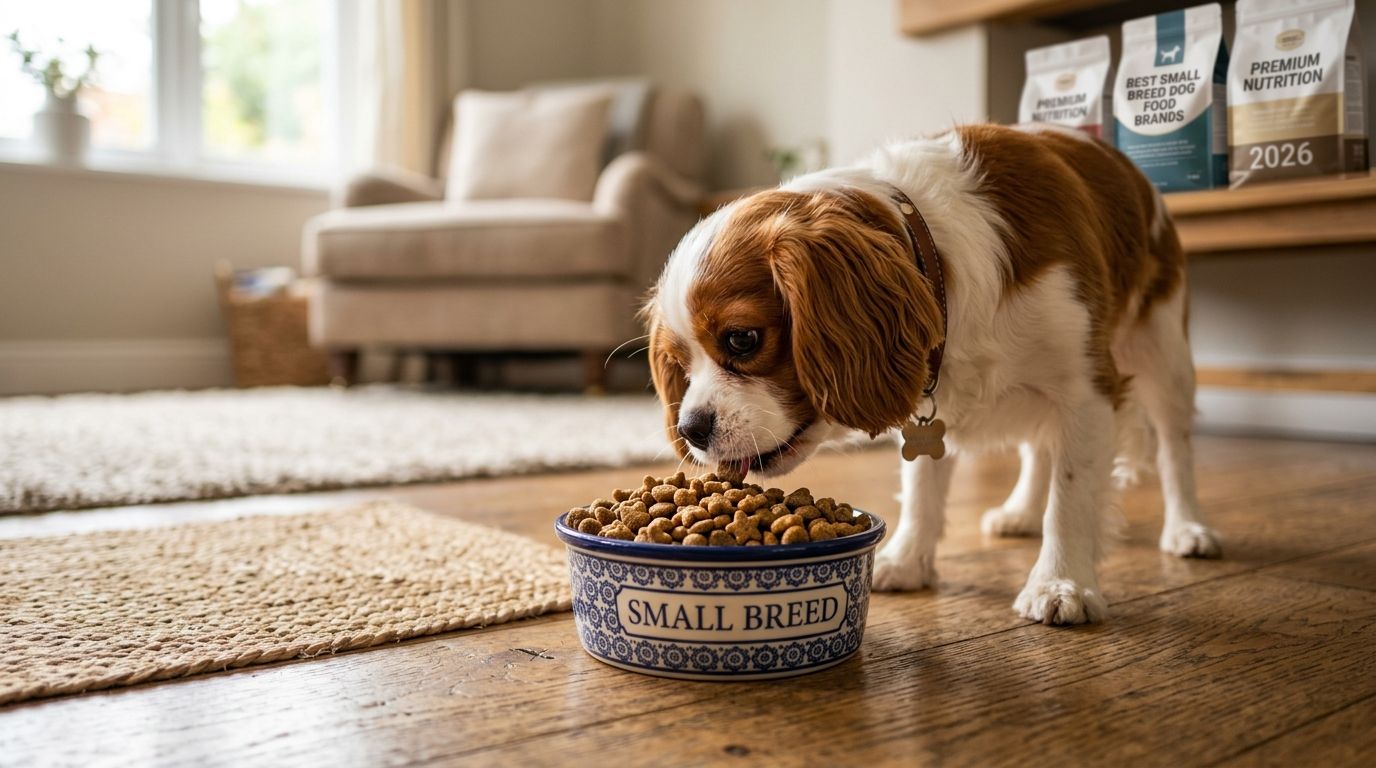
Six dog food brands stand out for small and toy breeds in 2026, and the right pick depends on your dog's age, stomach, and budget more than any marketing claim on the bag.
- Royal Canin Small Breed wins overall among the best small breed dog food brands for 2026.
- Hill's Science Diet Small Paws is the top pick for small-breed puppies under a year old.
- Wellness Complete Health Small Breed suits dogs with sensitive stomachs or loose stool.
- Purina Pro Plan Small Breed is the budget pick without cutting named-protein quality.
- Merrick Small Breed Grain-Free fits owners avoiding grain-based kibble entirely.
Why this matters
Small and toy breeds under roughly 25 pounds burn calories faster relative to their body size than large dogs, which is why a bag labeled "all life stages" for a Labrador can leave a Yorkie underfed on the same scoop size. Overfeeding runs the other direction too — small-breed obesity is one of the most common preventable health issues vets see, and it starts with a measuring cup built for a 60-pound dog. If you're shopping for Shop and Bark food or treats alongside a bowl and feeding routine that fits a small dog's space, matching the formula to the breed size matters as much as the ingredient list on the bag.
Many small-breed households also live in apartments or smaller homes, where the feeding station competes for floor space with the crate. If that's your setup, pairing the right food with crate furniture built for small apartments solves two problems at once.
Best overall: Royal Canin Small Breed. Best for puppies: Hill's Science Diet Small Paws. Best for sensitive stomachs: Wellness Complete Health Small Breed. Best for weight management: Blue Buffalo Small Breed. Best budget: Purina Pro Plan Small Breed. Best grain-free: Merrick Small Breed Grain-Free.
What makes the best small-breed dog food
- Kibble size matched to small jaws — pieces cut small enough for a Chihuahua or Yorkie molar, not a scaled-down version of a large-breed kibble
- Calorie density tuned to a fast metabolism — small dogs need more calories per pound of body weight than large breeds
- A clear AAFCO life-stage statement — growth, adult maintenance, or all life stages, printed on the bag
- A named animal protein listed first — chicken, salmon, or lamb, not a generic "meat meal"
- Identifiable, limited ingredient lists for dogs prone to skin or stomach sensitivity
- Consistent stock across major retailers so you're not reformulating your dog's diet every few months
Small-breed dog food brands at a glance
| Brand | Best for | Standout feature | Key limitation |
|---|---|---|---|
| Royal Canin Small Breed | Overall small-breed feeding | Breed-size-specific kibble shape and nutrient targeting | Formulas run narrow — less flexibility for dogs with allergies |
| Hill's Science Diet Small Paws | Puppies | Small-breed growth formula with vet-backed clinical research | Puppy formula only works until the dog reaches adult size |
| Wellness Complete Health Small Breed | Sensitive stomachs | Easily digestible recipe with limited filler ingredients | Fewer protein-source varieties than bigger competitors |
| Blue Buffalo Small Breed | Weight management | Higher protein-to-calorie ratio for lean muscle upkeep | Some lines include pea protein, which not every dog tolerates well |
| Purina Pro Plan Small Breed | Budget-conscious owners | Named-protein formula at a lower cost tier than boutique brands | Ingredient lists lean more processed than premium competitors |
| Merrick Small Breed Grain-Free | Grain-free diets | Grain-free recipe built around real meat as the first ingredient | Grain-free formulas cost more and aren't necessary for most dogs |
1. Royal Canin Small Breed: best small breed dog food for overall feeding
Royal Canin built its Small Breed line around the idea that a 6-pound Chihuahua and a 90-pound Mastiff shouldn't eat the same kibble shape or nutrient ratio. The kibble is sized and shaped specifically for smaller jaws, and the formula targets the faster metabolic rate typical of toy and small breeds.
Royal Canin Small Breed pros:
- Breed-size-specific kibble shape reduces gulping and choking risk
- Clear age-range formulas from puppy through senior
- Wide retail availability makes it easy to restock consistently
Royal Canin Small Breed cons:
- Recipes are less customizable for dogs with multiple food sensitivities
- Premium positioning means it costs more than mass-market small-breed bags
Verdict: Buy if you want a formula built specifically around small-breed biology with no guesswork.
2. Hill's Science Diet Small Paws: best small breed dog food for puppies
Hill's Science Diet Small Paws targets small-breed puppies during the window when they grow fastest, generally from weaning until they reach adult size around 9 to 12 months. The formula is built around clinical nutrition research rather than trend ingredients.
Hill's Science Diet Small Paws pros:
- Small kibble size appropriate for puppy mouths and developing teeth
- Backed by veterinary clinical nutrition research
- Widely recommended by veterinarians for growth-stage feeding
Hill's Science Diet Small Paws cons:
- Formula needs to switch once the puppy reaches adult size
- Ingredient lists skew more conventional than boutique competitors
Verdict: Buy if you're feeding a small-breed puppy and want a formula built on published research rather than marketing copy.
3. Wellness Complete Health Small Breed: best small breed dog food for sensitive stomachs
Wellness Complete Health Small Breed leans on a shorter, more digestible ingredient list, which makes it a common recommendation for small dogs with loose stool or food sensitivity issues. It still uses a named protein source as the primary ingredient.
Wellness Complete Health Small Breed pros:
- Easier digestion reported by owners of dogs with sensitive stomachs
- Named protein first, without excessive filler ingredients
- Small kibble sized appropriately for toy and small breeds
Wellness Complete Health Small Breed cons:
- Fewer protein-source options than larger competitors like Blue Buffalo
- Not formulated as a specialized limited-ingredient diet for severe allergies
Verdict: Buy if your small dog's stomach reacts poorly to richer or more processed formulas.
4. Blue Buffalo Small Breed: best small breed dog food for weight management
Blue Buffalo's Small Breed line pushes a higher protein-to-calorie ratio, aimed at keeping lean muscle on a dog while controlling calorie intake — useful given how quickly small breeds gain weight on oversized portions.
Blue Buffalo Small Breed pros:
- Higher protein ratio supports lean body condition
- Real meat listed as the first ingredient across the line
- Small-bite kibble reduces gulping
Blue Buffalo Small Breed cons:
- Some recipes include pea protein or legumes, which don't sit well with every dog
- Pricing sits above mass-market small-breed formulas
Verdict: Buy if your small dog needs to lose or maintain weight without losing muscle tone.
5. Purina Pro Plan Small Breed: best small breed dog food for budget feeding
Purina Pro Plan Small Breed delivers a named-protein formula at a lower cost tier than most of the boutique brands on this list, without dropping to generic "meat by-product" ingredient lists.
Purina Pro Plan Small Breed pros:
- Named protein source as the first ingredient
- Priced below most boutique small-breed competitors
- Backed by Purina's large-scale manufacturing and quality control
Purina Pro Plan Small Breed cons:
- Ingredient lists include more processed additives than premium lines
- Fewer specialty formulas for allergies or sensitivities
Verdict: Buy if you want dependable small-breed nutrition without boutique pricing.
6. Merrick Small Breed Grain-Free: best small breed dog food for grain-free diets
Merrick's Small Breed Grain-Free recipe replaces grain with alternative carbohydrate sources while keeping real meat as the first ingredient — a fit for owners who've decided against grain-based kibble specifically.
Merrick Small Breed Grain-Free pros:
- Real meat listed first, grain-free throughout
- Small kibble size built for toy and small breeds
- Wide flavor variety within the grain-free line
Merrick Small Breed Grain-Free cons:
- Costs more than grain-inclusive formulas on this list
- Grain-free isn't a nutritional necessity for most dogs without a diagnosed grain sensitivity
Verdict: Hold unless your dog has a confirmed grain sensitivity — otherwise a grain-inclusive formula covers the same nutritional ground for less.
How we ranked
Each brand is scored against the six criteria above: kibble size, calorie density, life-stage clarity, named protein sourcing, ingredient transparency, and retail consistency. No brand wins across every category — that's the point of a decision-tree ranking instead of a single leaderboard.
“If the kibble is bigger than your dog's molar, you're feeding a large-breed formula with a small-breed label.”
Which small breed dog food should you choose?
For most small-breed households in 2026, Royal Canin Small Breed is the default — it's built specifically around small-dog biology and covers puppy through senior life stages. Switch to Hill's Science Diet Small Paws if you're raising a puppy, to Wellness Complete Health Small Breed if stomach sensitivity is the issue, or to Purina Pro Plan Small Breed if cost is the deciding factor. Whatever you land on, pair it with a feeding setup sized for your dog — an oversized bowl or scoop undoes the benefit of a properly formulated bag.
Shop small-breed dog essentials
Browse food, treats, and gear sized for toy and small breeds.
FAQ
What is the best small breed dog food brand overall in 2026?
Royal Canin Small Breed is the best overall pick because it's formulated specifically around small-dog metabolism and kibble size across every life stage. Hill's Science Diet Small Paws and Wellness Complete Health Small Breed are the stronger picks for puppies and sensitive stomachs, respectively.
Is small breed dog food actually different from regular dog food?
Yes — small breed formulas use smaller kibble pieces and pack more calories per cup to match a small dog's faster metabolism. Feeding a large-breed formula to a toy breed can lead to underfeeding relative to their energy needs.
How much should I feed a small breed dog?
Follow the feeding chart on the specific bag you buy, since calorie density varies by brand and formula. Measuring by weight or a marked scoop, not by eyeballing, prevents the overfeeding that drives obesity in small breeds.
When should a small breed puppy switch to adult food?
Most small and toy breeds reach adult size between 9 and 12 months, which is when a puppy formula like Hill's Science Diet Small Paws should transition to an adult small-breed formula. Check the specific brand's age guidance since it varies slightly by breed size.
Is grain-free dog food better for small breeds?
No, grain-free isn't inherently better — it's only worth the added cost if your dog has a diagnosed grain sensitivity. Merrick Small Breed Grain-Free is a solid option for that specific case, but a grain-inclusive formula covers the same nutritional needs for most dogs.
What ingredients should I avoid in small breed dog food?
Avoid formulas where a generic "meat by-product" or filler grain leads the ingredient list instead of a named protein like chicken or salmon. Small dogs eat smaller total volumes daily, so ingredient quality matters more per bite.
Which small breed dog food is best for sensitive stomachs?
Wellness Complete Health Small Breed is the top choice for dogs with loose stool or food sensitivity because of its shorter, more digestible ingredient list. Introduce any new food gradually over 5 to 7 days to avoid stomach upset from the switch itself.
One last thing
The scoop that comes packaged with a large bag of dog food is almost always sized for a large-breed serving, not a 10-pound dog's portion — weigh the first few servings on a kitchen scale before trusting the scoop, since that single habit prevents more small-breed weight gain in 2026 than any brand switch will.